
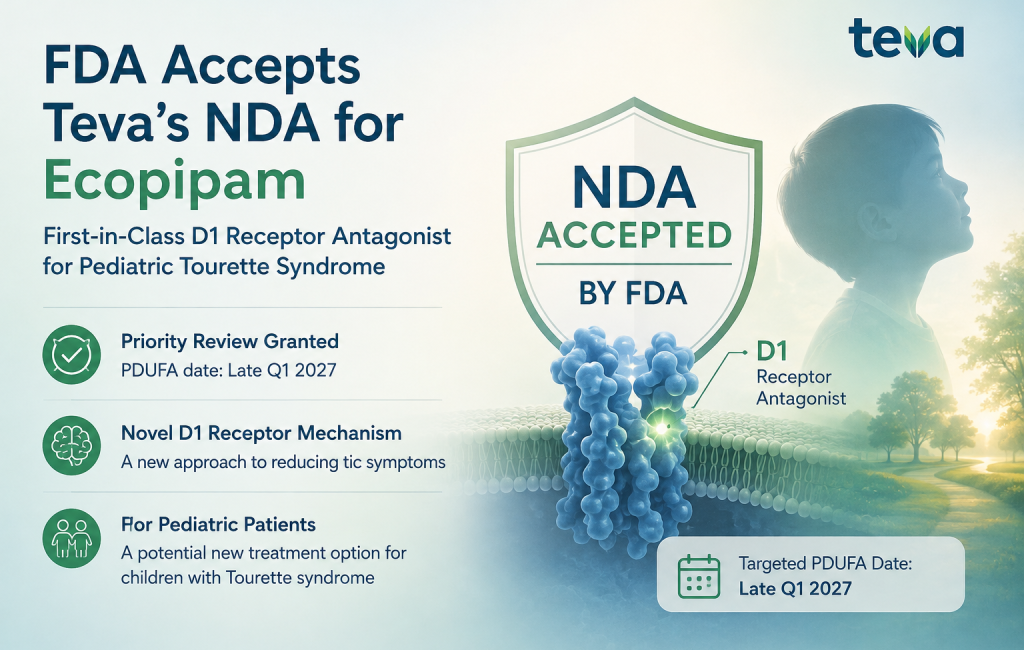
FDA accepts Teva’s NDA for ecopipam, a first-in-class D1 receptor antagonist for pediatric Tourette syndrome, with Priority Review and a Q1 2027 PDUFA date.
Written By: Shreya Desai, PharmD
Reviewed By: Pharmacally Editorial Team
Teva Pharmaceuticals announced that the U.S. Food and Drug Administration (FDA) has accepted its New Drug Application (NDA) for ecopipam (EBS-101), an investigational first-in-class selective dopamine D1 receptor antagonist being developed for pediatric patients with Tourette syndrome. The FDA granted Priority Review to the application and assigned a targeted PDUFA action date in late March 2027.
Tourette syndrome is a chronic neurodevelopmental disorder characterized by involuntary motor and vocal tics that typically begin during childhood. The condition can cause frequent and disruptive symptoms that affect daily activities and quality of life. According to Teva, approximately 100,000 children and adolescents in the United States are affected by the condition.
Ecopipam Offers a Novel Dopamine D1 Mechanism
Ecopipam is designed to selectively block dopamine D1 receptors. Its mechanism differs from dopamine D2 receptor-modulating therapies used in the management of Tourette syndrome and could provide a different pharmacological approach to controlling tic symptoms.
The investigational therapy has received FDA Orphan Drug designation for pediatric Tourette syndrome. Teva previously reported that ecopipam had also received Fast Track designation.
If approved, Teva states that ecopipam would be the first new treatment option indicated for pediatric patients with Tourette syndrome in more than 10 years and the first novel mechanism of action for the condition in more than 50 years.
NDA Supported by Phase 2b and Phase 3 Evidence
The NDA is supported by positive Phase 2b and Phase 3 clinical data.
The D1AMOND Phase 2b study (NCT05615220) was a 12-week randomized, double-blind, placebo-controlled trial involving 153 pediatric participants across 68 sites in North America and Europe. Ecopipam treatment produced a statistically significant and clinically meaningful improvement in the Yale Global Tic Severity Scale-Total Tic Score (YGTSS-TTS) compared with placebo at Week 12 (P=0.01). Participants who subsequently entered an open-label extension were followed for up to 12 months to assess long-term safety and tolerability.
The Phase 3 D1AMOND trial evaluated maintenance of efficacy using a randomized withdrawal design. A total of 216 pediatric and adult participants entered an open-label stabilization period, after which 104 responders were randomized, including 90 pediatric and 14 adult participants, across 77 sites in North America and Europe.
During the 12-week double-blind withdrawal period, pediatric participants who continued ecopipam had a significantly lower risk of relapse than those switched to placebo. Ecopipam reduced the risk of relapse by 53% over 12 weeks (hazard ratio, 0.47; 95% CI, 0.26–0.84; P=0.008).
Relapse was assessed using the YGTSS-TTS and included loss of treatment-related improvement, initiation of additional Tourette syndrome medication, or hospitalization because of worsening symptoms.
Safety and Tolerability
Across the Phase 2b, open-label extension and Phase 3 studies, Teva reported no clinically meaningful changes in body weight or BMI Z-score, vital signs, laboratory and metabolic parameters, ECG measurements, drug-induced movement disorder assessments, or measures of psychiatric comorbidities.
Common adverse events reported in pediatric patients included headache, insomnia, fatigue, somnolence, tics, anxiety, nausea and restlessness.
The Phase 3 findings were recently published in JAMA Neurology, providing additional peer-reviewed evidence supporting the ecopipam clinical development program.
Regulatory Outlook
With FDA acceptance and Priority Review now granted, the next major milestone is the agency’s regulatory decision, targeted for late March 2027.
If approved, ecopipam could introduce a new dopamine D1 receptor-based treatment approach for pediatric patients with Tourette syndrome, a population for which Teva identifies continued unmet treatment needs.
Reference

About the Writer
Shreya Desai is a Doctor of Pharmacy professional with a strong academic record, having secured Rank 1 for three consecutive years, and a keen interest in clinical writing, clinical research, regulatory affairs, and pharmacovigilance.
With experience in medical communication and scientific writing, she brings strong research aptitude, scientific acumen, and effective communication skills to healthcare content development.
As a Pharmacally healthcare writer, Shreya focuses on creating clear, accurate, evidence-based medical content while translating complex scientific information into meaningful healthcare communication.