
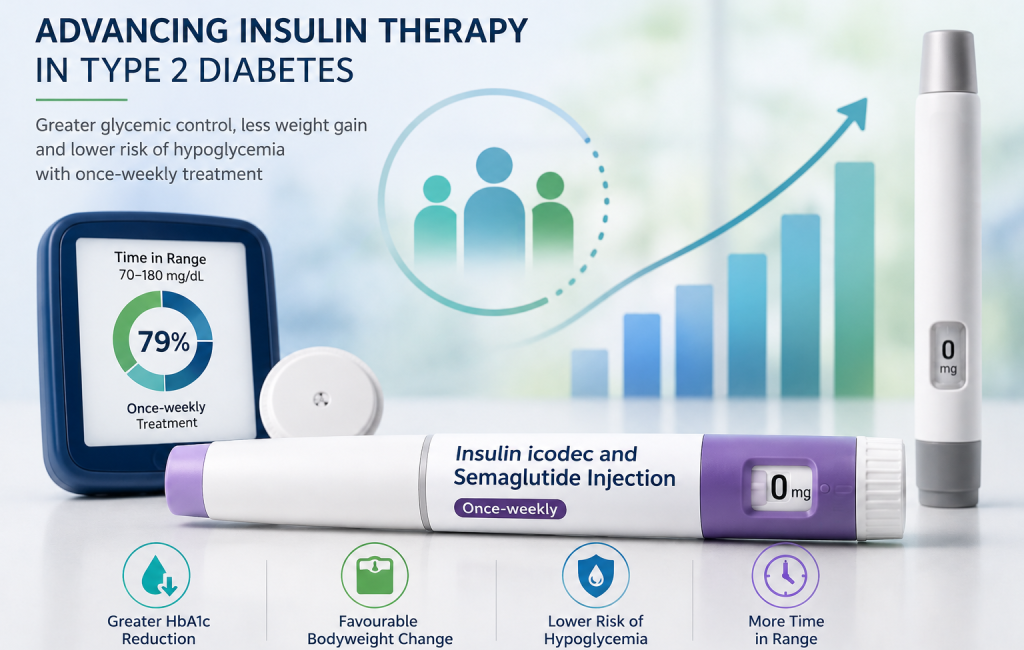
COMBINE 4 found once-weekly IcoSema improved HbA1c, bodyweight and time in range versus insulin glargine U100 in type 2 diabetes.
Written By: Kirti Kumbhar,
M.Pharm (Reg. Affairs)
Reviewed By: Pharmacally Editorial Team
Type 2 diabetes often requires treatment intensification when oral glucose-lowering medicines do not provide adequate glycaemic control. IcoSema is an investigational once-weekly combination of basal insulin icodec and semaglutide, a glucagon-like peptide-1 receptor agonist. The COMBINE 4 trial, sponsored by Novo Nordisk A/S, evaluated this once-weekly approach against once-daily insulin glargine U100 in insulin-naive adults with type 2 diabetes inadequately controlled on oral glucose-lowering medications.
The findings, published online on August 13, 2026, in The Lancet Diabetes & Endocrinology, showed that IcoSema provided greater reductions in HbA1c and more favourable bodyweight changes than insulin glargine U100, while also showing a lower rate of combined clinically significant or severe hypoglycaemia.
What Did the COMBINE 4 Trial Evaluate?
COMBINE 4 (NCT06269107) was a 40-week, randomised, open-label, treat-to-target phase 3b trial conducted at 97 sites across nine countries. It enrolled adults aged 18 years or older with insulin-naive type 2 diabetes, HbA1c of at least 8.0%, and inadequate glycaemic control despite oral glucose-lowering treatment.
A total of 485 participants were randomised, with 243 assigned to once-weekly IcoSema and 242 to once-daily insulin glargine U100. Treatment was titrated toward a blood glucose target of 3.9–5.0 mmol/L (70–90 mg/dL). The primary endpoint was change in HbA1c from baseline to week 40, while change in bodyweight was the secondary confirmatory endpoint. Adverse events were assessed through week 45.
IcoSema Produced Greater HbA1c Reduction
At baseline, mean HbA1c was 9.57% in the IcoSema group and 9.50% in the insulin glargine group.
By week 40, HbA1c had decreased by 3.32 percentage points with IcoSema compared with 2.44 percentage points with insulin glargine U100. The estimated treatment difference was −0.88 percentage points (95% CI −1.12 to −0.63; p<0.001), confirming statistical superiority of IcoSema for the primary endpoint.
Additional Continuous glucose monitoring also showed an advantage for IcoSema. During weeks 36–40, participants receiving IcoSema spent a greater proportion of time in the target glucose range of 70–180 mg/dL than those receiving insulin glargine U100, with mean Time in Range of 79.8% versus 64.5%, respectively. Time spent below 54 mg/dL was similar between the groups.
Bodyweight Outcomes Also Favoured IcoSema
Bodyweight showed a different pattern between the two treatment groups. Mean bodyweight decreased by 0.79 kg from baseline with IcoSema, whereas it increased by 3.81 kg with insulin glargine U100.
The estimated treatment difference was −4.61 kg (95% CI −5.46 to −3.75; p<0.001), confirming statistical superiority for the secondary confirmatory endpoint.
Hypoglycaemia and Safety Findings
The rate of combined clinically significant or severe hypoglycaemia was also lower with IcoSema. Rates were 0.29 episodes per person-year with IcoSema versus 0.59 episodes per person-year with insulin glargine U100, corresponding to an estimated rate ratio of 0.56 (95% CI 0.32–0.97; p=0.04).
Clinically significant hypoglycaemia was defined as blood glucose below 3.0 mmol/L (54 mg/dL), confirmed using a blood glucose meter. Severe hypoglycaemia involved severe cognitive impairment requiring external assistance for recovery. Gastrointestinal disorders were the most frequently reported adverse events with IcoSema.
How Does COMBINE 4 Fit into the IcoSema Evidence?
COMBINE 4 adds to the earlier phase 3a COMBINE programme. COMBINE 1 (NCT05352815) evaluated IcoSema against insulin icodec in people already receiving basal insulin, while COMBINE 2 (NCT05259033) compared IcoSema with once-weekly semaglutide in people inadequately controlled on GLP-1 receptor agonist therapy. COMBINE 3 (NCT05013229) compared IcoSema with multiple daily insulin injections. Together, these studies evaluated IcoSema across different treatment settings.
What Do These Findings Mean?
In COMBINE 4, once-weekly IcoSema demonstrated statistical superiority over once-daily insulin glargine U100 for both HbA1c reduction and bodyweight change, while the rate of combined clinically significant or severe hypoglycaemia was also lower.
However, the trial was open-label and lasted 40 weeks, so it does not establish long-term cardiovascular outcomes, durability beyond the study period, cost-effectiveness, or real-world adherence. IcoSema remains an investigational therapy, and these findings do not by themselves establish regulatory approval.
Reference

About the Writer
Kirti Kumbhar (LinkedIn) is an M.Pharm graduate with experience in Quality Assurance at Lupin Limited and a strong interest in clinical research, regulatory affairs, and Trial Master File (TMF) management. She has developed knowledge of regulatory documentation, quality systems, compliance, and healthcare research through her professional experience. Passionate about clinical development and continuous learning, Kirti is committed to supporting high-quality healthcare documentation, regulatory excellence, and research-driven healthcare advancements.