
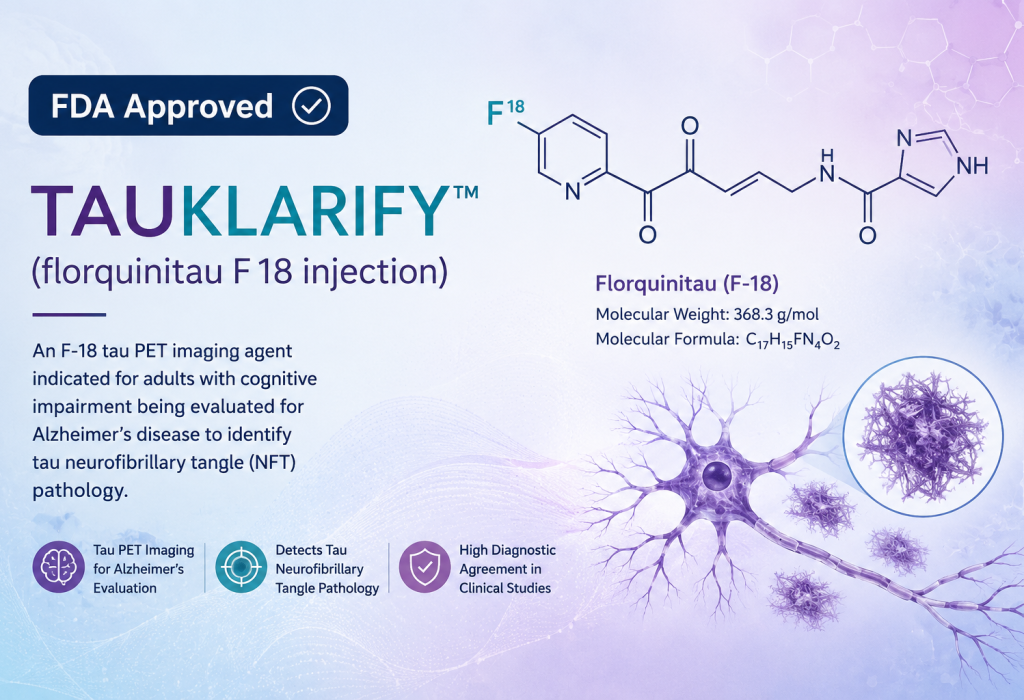
The FDA approved Lantheus’ TAUKLARIFY, an F-18 tau PET agent for detecting tau neurofibrillary tangle pathology in adults evaluated for Alzheimer’s disease.
Written By: Saniya Katakdhond, PharmD
Reviewed By: Pharmacally Editorial Team
Lantheus has received U.S. FDA approval for TAUKLARIFY (florquinitau F 18 injection, also known as MK-6240), an F-18-labeled tau PET imaging agent for adults with cognitive impairment undergoing evaluation for Alzheimer’s disease. The approval adds a tau-directed imaging tool that can identify brain tau neurofibrillary tangle pathology alongside established Alzheimer’s diagnostic approaches.
FDA Approval Targets Tau Pathology in Alzheimer’s Disease
TAUKLARIFY is indicated for brain positron emission tomography (PET) in adults with cognitive impairment who are being evaluated for Alzheimer’s disease to identify patients with tau neurofibrillary tangle (NFT) pathology.
The label includes a limitation of use: safety and effectiveness have not been established for evaluating non-Alzheimer’s disease tauopathies.
Tau NFTs are a defining pathological feature of Alzheimer’s disease and develop alongside other disease-associated changes, including amyloid-beta pathology. Tau PET can therefore provide complementary information to amyloid PET and other clinical and biomarker assessments.
Blinded Studies Demonstrated High Reader Agreement
The approval was supported by two blinded image-read studies involving more than 500 subjects enrolled across three clinical trials. The development program included people with mild cognitive impairment, mild Alzheimer’s disease dementia and cognitively unimpaired individuals, allowing evaluation across different stages of cognitive function.
Participants received an approximate intravenous dose of 185 MBq (5 mCi) of TAUKLARIFY for PET imaging. Independent readers, trained in image interpretation and blinded to clinical information and amyloid-beta PET findings, classified scans as positive or negative for tau NFT pathology.
In Study 1, which evaluated 279 subjects, positive percent agreement across readers ranged from 80% to 88%, while negative percent agreement ranged from 98% to 99%. Inter-reader agreement was high, with a generalized Fleiss’ kappa of 0.92.
Study 2 included 338 subjects and showed positive percent agreement ranging from 68% to 82% and negative percent agreement from 93% to 99%. The generalized Fleiss’ kappa was 0.86, again demonstrating high agreement among readers.
Together, the findings supported the ability of trained readers to consistently interpret TAUKLARIFY PET scans for tau pathology.
Safety Profile Across 1,734 Subjects
Safety was evaluated in 1,734 subjects. Reported adverse reactions occurring in at least 0.1% of participants included headache in 0.7%, nausea in 0.2%, injection-site reactions in 0.1%, dizziness in 0.1% and abdominal discomfort in 0.1%.
As an F-18 radiopharmaceutical, TAUKLARIFY also requires appropriate handling and administration within nuclear medicine settings.
Tau Imaging Could Complement Alzheimer’s Biomarker Assessment
Lantheus Executive Chairperson and CEO Mary Anne Heino said the approval reflects the growing role of tau imaging in Alzheimer’s disease assessment. She highlighted the potential for tau PET to complement amyloid PET and other diagnostic tools as clinicians seek a more complete picture of disease pathology.
Keith Johnson, Professor of Neurology and Radiology at Massachusetts General Hospital and Harvard Medical School, described quantitative tau PET as an important tool for identifying tau pathology and supporting research into disease impact and emerging treatments.
The approval comes as biomarker-defined diagnosis becomes increasingly important in Alzheimer’s disease, particularly as disease-modifying therapies require more precise characterization of underlying pathology.
Lantheus Evaluates Commercial Availability
Following the FDA decision, Lantheus said it will continue supporting Alzheimer’s disease therapeutic programs through its Pharma Solutions business while evaluating the appropriate path toward broader commercial availability of TAUKLARIFY.
The company’s next steps will depend partly on developments in the Alzheimer’s treatment landscape and the needs of pharmaceutical and clinical partners. The approval provides another FDA-cleared approach for visualizing tau pathology and could strengthen the biomarker infrastructure supporting both clinical assessment and development of emerging Alzheimer’s therapies.
Reference

About the Writer
Saniya Sanjay Katakdhond (Linkedin) is a Doctor of Pharmacy professional with hands-on experience in patient case review, clinical documentation, medical record analysis, and patient care.
Her hospital experience has strengthened her understanding of clinical conditions, treatment approaches, and multidisciplinary healthcare practices.
With ICH-GCP certification and a research-oriented approach, she brings clinical insight and attention to detail to healthcare content development.
As a healthcare writer, Saniya focuses on translating clinical knowledge and patient-care experience into clear, accurate, and evidence-informed medical content.