
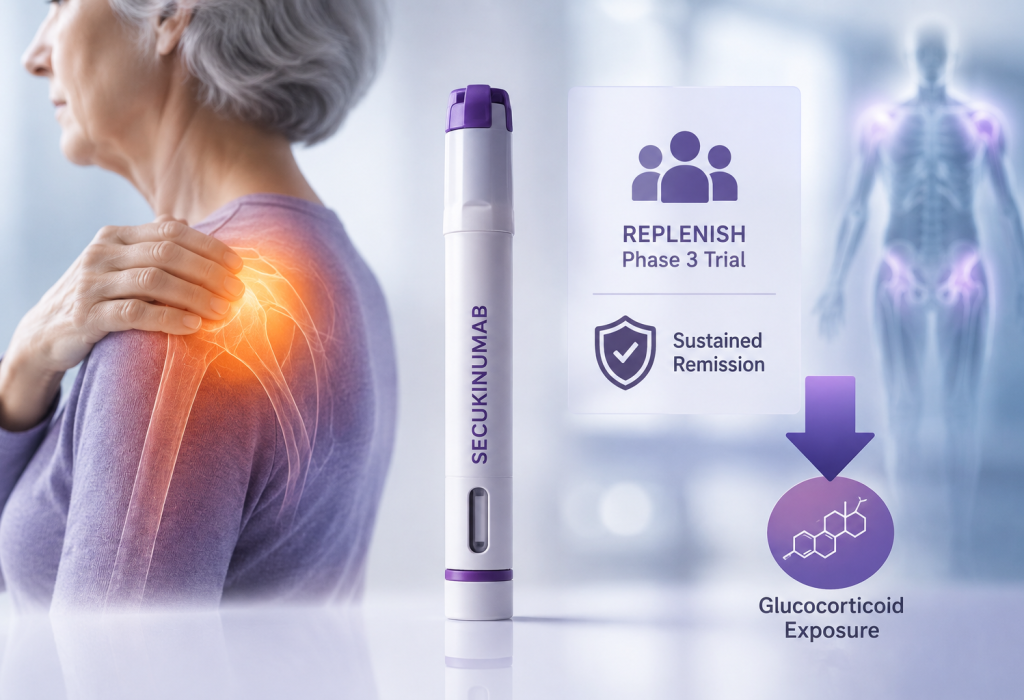
Phase 3 REPLENISH data show secukinumab improved sustained remission and reduced glucocorticoid exposure in relapsed polymyalgia rheumatica.
Written By: Anamika Koshti, PharmD
Reviewed By: Pharmacally Editorial Team
A Phase 3 trial published in the New England Journal of Medicine showed that secukinumab significantly improved sustained remission in patients with recently relapsed polymyalgia rheumatica (PMR) when administered alongside a 24-week glucocorticoid taper. The REPLENISH trial met its primary endpoint and all prespecified key secondary endpoints, providing Phase 3 evidence supporting IL-17A inhibition as a potential treatment approach for relapsed PMR.
Addressing a Steroid-Dependent Disease
PMR is an inflammatory rheumatic disease that primarily affects adults older than 50 years and is characterized by pain and stiffness, particularly involving the shoulders, hips, and often the neck. Glucocorticoids remain the mainstay of treatment, but relapses are common during dose reduction, and prolonged glucocorticoid exposure can lead to complications including osteoporosis, infections, diabetes, and cardiovascular complications.
In the United States, sarilumab, an interleukin-6 receptor antagonist, is approved for adults with PMR who have had an inadequate response to corticosteroids or cannot tolerate corticosteroid tapering. The need for additional steroid-sparing treatment options remains important, particularly for patients with recurrent disease and increased risk from prolonged glucocorticoid exposure.
Trial Design
The REPLENISH trial (NCT05767034) was a global, multicenter, randomized, double-blind, placebo-controlled Phase 3 study conducted across 27 countries. It enrolled 381 adults aged 50 years or older with a recent PMR relapse. Participants were randomized in a 1:1:1 ratio to receive subcutaneous secukinumab 300 mg (SEC-300, n=127), secukinumab 150 mg (SEC-150, n=127), or placebo (n=127) for 52 weeks. All three groups also received a standardized prednisone taper over 24 weeks. Secukinumab was administered weekly for the first four weeks and then every four weeks.
The primary endpoint was sustained remission at Week 52. Sustained remission required patients to achieve remission at Week 12 and maintain it through Week 52 without recurrence of PMR signs or symptoms requiring escape or rescue treatment and without a new diagnosis of giant-cell arteritis requiring such treatment. Key secondary endpoints included complete sustained remission, adjusted annual cumulative glucocorticoid dose, and time to first escape or rescue treatment.
Efficacy Results
At Week 52, sustained remission was achieved in 41.2% of patients in the SEC-300 group and 40.6% of those in the SEC-150 group, compared with 20.4% in the placebo group. Both secukinumab doses were statistically superior to placebo, with P<0.001 for each comparison. The corresponding 95% confidence intervals were 32.8 to 49.7% for SEC-300, 32.2 to 49.0% for SEC-150, and 13.6 to 27.2% for placebo.
A more stringent measure, complete sustained remission, which additionally incorporated control of inflammatory markers, was achieved in 28.2% of patients receiving SEC-300 and 24.5% receiving SEC-150, compared with 4.7% receiving placebo. Both secukinumab doses were superior to placebo on this secondary endpoint.
Secukinumab also prolonged the time before patients required escape or rescue treatment. The median time to first escape or rescue treatment was approximately 337 days with SEC-300 and 282 days with SEC-150, compared with 157 days with placebo. These findings were consistent with the higher sustained remission rates observed with secukinumab.
Glucocorticoid-Sparing Effect
A key secondary endpoint was the adjusted annual cumulative glucocorticoid dose through Week 52. The mean adjusted dose was 1,603.7 mg in the SEC-300 group and 1,683.2 mg in the SEC-150 group, compared with 2,093.0 mg in the placebo group.
The lower cumulative glucocorticoid exposure supports a steroid-sparing effect of secukinumab when used with the 24-week prednisone taper. This finding is particularly relevant in PMR, where recurrent disease can result in prolonged glucocorticoid treatment and associated toxicity.
Safety Profile
No new safety signals were identified in the trial. Serious adverse events occurred in 13.5% of patients receiving SEC-300, 15.9% receiving SEC-150, and 14.2% receiving placebo. Overall, serious adverse-event rates were broadly comparable across treatment groups.
Nasopharyngitis, hypersensitivity reactions, urinary tract infections, fungal infections, and back pain were reported more frequently in the secukinumab groups than in the placebo group. The safety findings were generally consistent with the established safety profile of secukinumab in its approved indications.
Regulatory and Clinical Context
Secukinumab (Cosentyx) is approved for several immune-mediated inflammatory diseases, but polymyalgia rheumatica remains an investigational indication. Novartis completed regulatory submissions for PMR in the United States, Europe, and Japan in the first quarter of 2026.
The REPLENISH findings contrast with a separate Phase 3 study of secukinumab in giant-cell arteritis, which did not meet its primary endpoint. Together, the findings underscore that efficacy observed in relapsed PMR should not automatically be extrapolated to related inflammatory diseases.
What This Means for Patients?
For patients with recently relapsed PMR, REPLENISH suggests that secukinumab could provide a potential steroid-sparing treatment option if approved for this indication. The treatment increased sustained remission and reduced cumulative glucocorticoid exposure compared with placebo plus a 24-week prednisone taper.
Secukinumab was not tested as a replacement for glucocorticoids at treatment initiation. All patients in the trial received a 24-week prednisone taper, so the findings support secukinumab as a potential glucocorticoid-sparing strategy rather than immediate steroid discontinuation. Its use in PMR remains investigational pending regulatory review.
Reference
Phase 3 Trial of Secukinumab in Polymyalgia Rheumatica | New England Journal of Medicine

About the Writer
Anamika Koshti (LinkedIn) is a PharmD professional and healthcare writer with interests in clinical research, pharmacovigilance, and evidence-based medicine. She has authored peer-reviewed publications on Alzheimer’s disease and PCOS, presented research at national conferences, and gained hands-on experience in medical content development and clinical data interpretation. She is committed to translating complex medical research into accurate, accessible content for healthcare professionals and patients.