
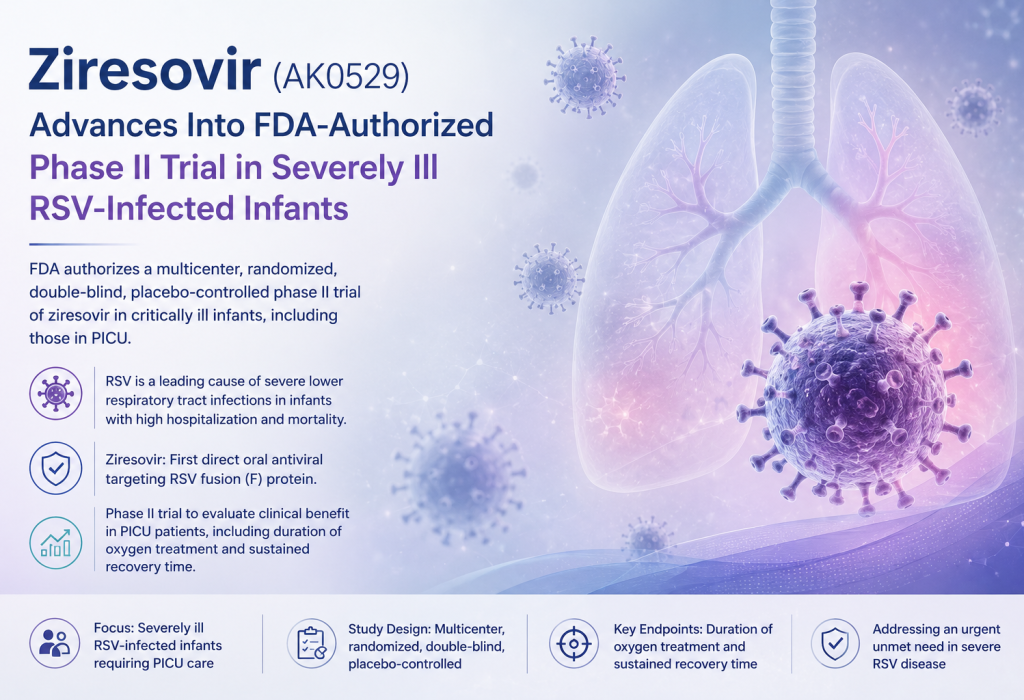
FDA authorizes a phase II trial of ziresovir in severely ill RSV-infected infants requiring PICU care, expanding development of the antiviral.
Written By: Kalyani Boharapi,
M.Pharm (Reg. Affairs)
Reviewed By: Pharmacally Editorial Team
Ark Biopharmaceutical (ArkBio) has received U.S. Food and Drug Administration (FDA) authorization to initiate a multicenter phase II trial of ziresovir (AK0529) in severely ill infants with respiratory syncytial virus (RSV) infection, including patients requiring care in pediatric intensive care units (PICUs). The trial extends clinical development of the oral antiviral into one of the highest-risk RSV populations, where treatment options remain limited.
Severe RSV Creates a Major Treatment Gap
RSV is a leading cause of lower respiratory tract infection in infants and young children, contributing to an estimated 33 million LRTI cases, 3.6 million hospitalizations, and more than 100,000 deaths globally each year. Severe disease can progress rapidly to respiratory failure, requiring oxygen, mechanical ventilation, and intensive monitoring in the PICU.
Current management of severe RSV in infants remains largely supportive. The lack of an effective, routinely used RSV-specific antiviral for hospitalized children leaves a substantial therapeutic gap, particularly in critically ill patients.
Ziresovir Targets RSV Entry
Ziresovir is an orally administered small-molecule inhibitor of the RSV fusion (F) protein. By binding the prefusion form of the F protein, the drug interferes with viral membrane fusion and limits infection of new host cells.
Its clinical development has already produced positive phase III data in hospitalized infants aged 1 to 24 months. In the AIRFLO study, ziresovir significantly improved the Wang bronchiolitis clinical score compared with placebo at 48 hours and produced a greater reduction in RSV viral load.
Phase II Trial Will Focus on PICU Patients
The newly authorized randomized, double-blind, placebo-controlled phase II study will enroll severely ill RSV-infected infants hospitalized in PICUs. The principal clinical measures will include duration of oxygen treatment and sustained recovery time, with the results expected to inform subsequent registrational development in this population.
The move into critically ill infants builds on evidence from the phase III AIRFLO trial (NCT04231968). That study enrolled 244 RSV-confirmed participants in the intention-to-treat population and 302 in the safety population. Ziresovir reduced the Wang bronchiolitis clinical score by 3.4 points from baseline to day 3, compared with 2.7 points with placebo, producing a between-group difference of −0.8 points (P=0.002). Viral load also declined more rapidly with treatment, with a day-5 difference of −0.6 log10 copies/mL versus placebo (P=0.006).
Safety findings were broadly comparable between groups. Drug- or placebo-related adverse events occurred in 16% of ziresovir-treated participants and 13% of those receiving placebo. Diarrhea, elevated liver enzymes, and rash were among the most frequently reported treatment-related events. Resistance-associated mutations occurred in 9% of ziresovir-treated participants, an important consideration for further development of an RSV fusion inhibitor.
Development Expands to the Most Severe Disease
Additional phase III analyses (NCT04231968) in infants aged 6 months or younger showed a greater improvement in bronchiolitis scores with ziresovir than placebo, supporting activity in a particularly vulnerable subgroup. The study also followed participants for 24 months, with findings reported in The Lancet Child & Adolescent Health.
ArkBio said the FDA authorization represents an important expansion of ziresovir development toward patients with the greatest clinical need. The new phase II study will provide data on whether the antiviral benefits observed in hospitalized infants can translate into clinically meaningful reductions in oxygen dependence and recovery time among critically ill PICU patients.
The results will determine the next stage of registrational development for ziresovir in severe pediatric RSV infection and could help establish a treatment strategy for infants whose disease progresses beyond conventional supportive care.
Reference
ArkBio’s RSV Antiviral Drug Ziresovir Receives FDA Approval for Phase II Clinical Trial

About the Writer
Kalyani Boharapi (LinkedIn) is a pharmacy professional and healthcare writer currently pursuing an M.Pharm in Regulatory Affairs at Dr. D. Y. Patil College of Pharmacy, with interests in pharmaceutical regulations, drug development, and healthcare innovation. She has academic exposure to dossier preparation, scientific writing, and regulatory documentation. Kalyani has also completed certification courses in Generative AI, AI in Pharma, and Bioinformatics, and actively participates in pharmaceutical conferences to stay updated with emerging trends and advancements in the healthcare and pharmaceutical industry.