
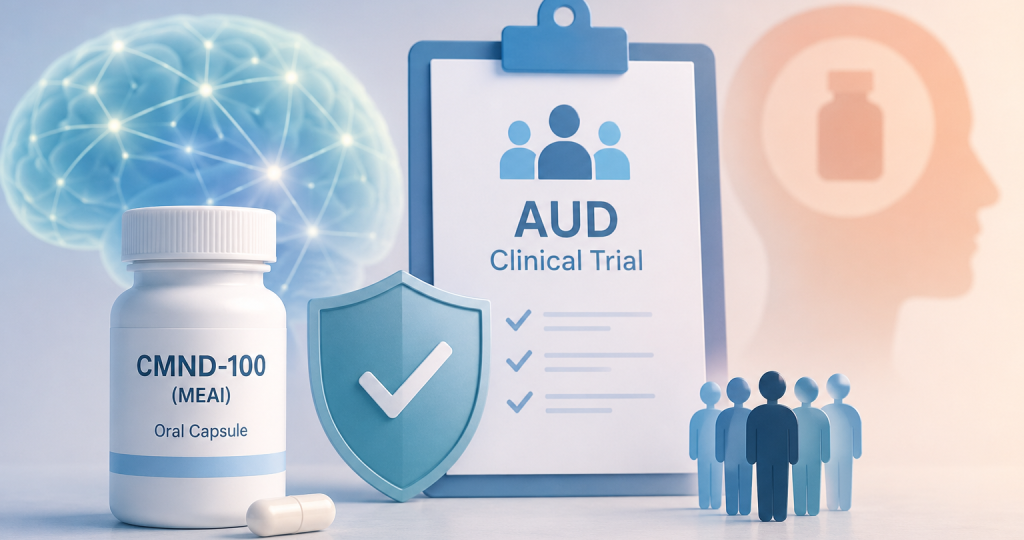
Clearmind advances its Phase I/II CMND-100 trial into patients with moderate-to-severe alcohol use disorder after DSMB confirms Part A safety.
Written By: Nakum Mansi, Pharm.D
Reviewed By: Pharmacally Editorial Team
Clearmind Medicine has received unanimous approval from an independent Data and Safety Monitoring Board (DSMB) to advance its FDA-regulated Phase I/II trial of CMND-100 into Parts B and C, following successful completion of Part A. The move will bring CMND-100 into patients with moderate-to-severe alcohol use disorder (AUD) for the first time, expanding clinical evaluation beyond healthy participants.
DSMB Clears Progression After Part A Safety Review
The DSMB reviewed the full safety dataset from Part A and concluded that CMND-100 met its primary safety endpoint, with a favorable safety and tolerability profile across all planned dose levels in healthy participants.
Based on these findings, the independent committee unanimously recommended progression to Parts B and C under the previously approved protocol.
The transition marks an important step in the clinical development of CMND-100 because Part B will provide the first evaluation of the candidate in people actively living with moderate-to-severe AUD.
Part B Will Test CMND-100 in Patients With AUD
Part B will enroll two sequential cohorts of six patients each. The first cohort will receive 80 mg of CMND-100, followed by a second cohort receiving 160 mg.
Investigators will assess safety and tolerability while also looking for early signals of clinical activity. These exploratory assessments will include CMND-100’s potential effects on alcohol consumption and alcohol craving.
The study is not yet positioned to establish efficacy. Instead, findings from Part B are expected to provide an initial assessment of how the candidate performs in the target patient population and inform subsequent clinical development.
Part C will run concurrently with Part B in healthy participants. This segment will evaluate a fixed 160 mg daily dose administered for five consecutive days in a double-blind, placebo-controlled setting. The objective is to further characterize CMND-100’s safety and tolerability with repeated dosing.
Oral MEAI Formulation Targets AUD
CMND-100 is Clearmind’s proprietary oral formulation of 5-methoxy-2-aminoindane (MEAI), a non-hallucinogenic, neuroplastogen-derived compound.
The company is developing MEAI based on its potential to promote adaptive neuroplasticity without the perceptual effects associated with classical psychedelics. Clearmind’s approach could potentially support treatment models that do not require the prolonged monitoring and intensive clinical supervision associated with some psychedelic-based interventions.
AUD remains a major clinical challenge, particularly among patients with moderate-to-severe disease who continue to experience problematic drinking and craving despite available treatment options. The clinical program is therefore evaluating whether CMND-100 can produce measurable changes in drinking patterns while maintaining an acceptable safety profile.
Clinical Program Includes U.S. and Israeli Sites
The Phase I/II study is evaluating safety, tolerability, pharmacokinetics and preliminary efficacy related to drinking patterns and alcohol craving in individuals with moderate-to-severe AUD.
Clinical sites include Johns Hopkins University, Yale School of Medicine, Tel Aviv Sourasky Medical Center and Hadassah Medical Center.
Clearmind Chief Executive Officer Dr. Adi Zuloff-Shani said the DSMB decision allows the company to move from dose escalation and safety assessment into evaluation of CMND-100 in the population it intends to treat.
Next Milestone: Enrollment in AUD Patients
With DSMB clearance for Parts B and C, the immediate focus shifts to enrollment and clinical evaluation in the AUD population. Data from these segments will help characterize CMND-100’s safety, tolerability and pharmacokinetic profile while providing the first clinical assessment of potential effects on alcohol consumption and craving in patients.
The company expects to provide further updates as enrollment progresses and the Phase I/II program advances.
Reference
Clearmind Advances CMND-100 to Alcohol Use Disorder Patients After Achieving Primary Safety Endpoint

About the Writer
Mansi Nakum (Linkedin) is a Pharm.D professional with a strong foundation in clinical pharmacy, evidence-based healthcare writing, and clinical data interpretation.
She has published work on Brugada syndrome and has a keen interest in guideline integration, multimodal therapy, pharmacogenomics, and antibiogram utilization.
As a healthcare writer, she focuses on translating clinical evidence into clear, accurate, and clinically relevant content, while continuously developing her expertise in evolving pharmacy practice.