
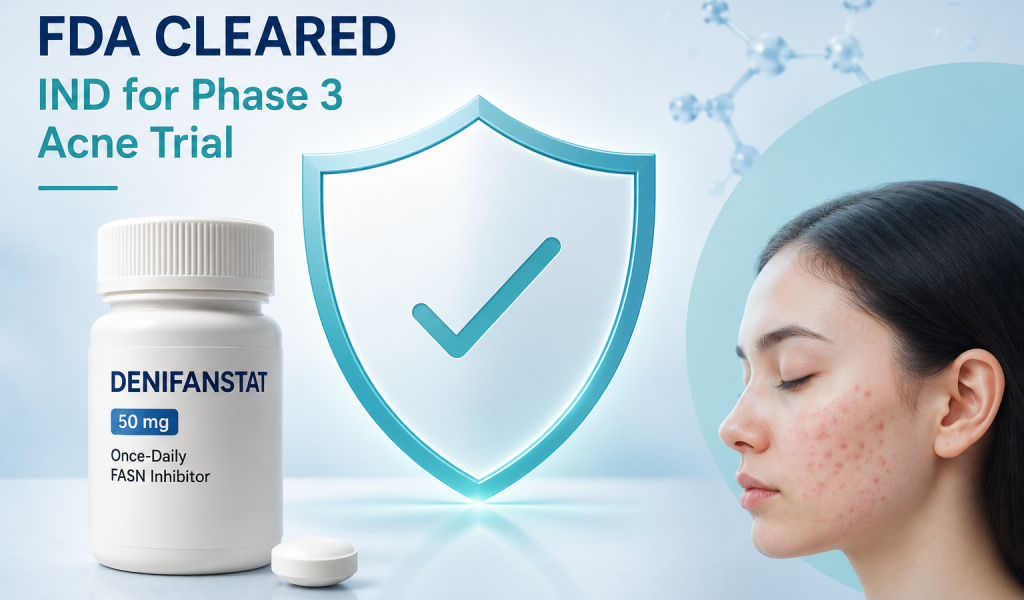
Sagimet Biosciences receives FDA clearance for its Phase 3 denifanstat trial in moderate to severe acne, with U.S. enrollment planned for 2026.
Written By: Kalyani Boharapi,
M.Pharm (Reg. Affairs)
Reviewed By: Pharmacally Editorial Team
Sagimet Biosciences has received clearance from the U.S. Food and Drug Administration for its Investigational New Drug (IND) application for denifanstat in moderate to severe acne. The FDA has also issued a “Study May Proceed” letter, allowing the company to advance its planned Phase 3 clinical trial in the United States.
The company said the Phase 3 trial is on track to initiate in the second half of 2026. The study is expected to enroll approximately 800 patients aged 12 years and older, including about 450 adolescents aged 12 to 17 years.
Denifanstat is an oral, once-daily fatty acid synthase (FASN) inhibitor being developed by Sagimet for moderate to severe acne. The FDA clearance represents a regulatory milestone for the program and enables the company to proceed with the planned late-stage clinical evaluation in the United States.
Phase 3 trial will evaluate denifanstat over 12 weeks
The Phase 3 study is designed as a multicenter, randomized, double-blind, placebo-controlled clinical trial in patients with moderate to severe acne.
Approximately 800 U.S. patients aged 12 years and older will be enrolled, with approximately 450 expected to be adolescents aged 12 to 17 years. Participants will be randomized in a 2:1 ratio to receive either denifanstat 50 mg or placebo once daily for 12 weeks.
The trial has three co-primary endpoints that will be assessed at Week 12.
The first endpoint will evaluate the proportion of patients achieving treatment success based on a global assessment score. Treatment success is defined as at least a 2-point reduction from baseline, with a final score of 0, corresponding to clear skin, or 1, corresponding to almost clear skin.
The other two co-primary endpoints will assess the absolute change from baseline in inflammatory skin lesion counts and non-inflammatory skin lesion counts.
Patients completing the 12-week randomized double-blind period will be eligible to enter a 40-week open-label extension. The extension is intended to evaluate the long-term safety of denifanstat.
FDA clearance follows Phase 3 results from China
The U.S. development program is supported by clinical results generated in China by Sagimet’s licensing partner, Ascletis BioScience Co. Ltd.
According to Sagimet, denifanstat met all primary and secondary endpoints in a 12-week randomized, double-blind Phase 3 clinical trial in patients with moderate to severe acne vulgaris.
The company also reported that denifanstat was generally well tolerated in the clinical program. In a separate open-label Phase 3 clinical trial evaluating long-term safety, improvements were observed across all efficacy endpoints measured at 52 weeks.
These clinical findings form part of the evidence supporting the continued development of denifanstat for moderate to severe acne outside China.
Denifanstat targets fatty acid synthase
Denifanstat is an oral, once-daily inhibitor of fatty acid synthase, or FASN, being developed as a treatment for moderate to severe acne.
The therapy is being developed by Ascletis as ASC40 for acne in China, while Sagimet is developing denifanstat in the rest of the world.
In announcing the FDA clearance, Sagimet described denifanstat as a novel oral, once-daily treatment approach for acne. The company is evaluating the therapy with the goal of establishing its efficacy and safety in a U.S. population that includes both adolescents and adults.
Moderate to severe acne remains a significant treatment burden
Acne is among the most common skin conditions in the United States. According to Sagimet, approximately 50 million Americans are affected by acne each year, while more than 5 million seek medical treatment annually.
The condition affects approximately 85% of people between 12 and 24 years of age. Moderate to severe acne represents approximately 20% of acne cases, corresponding to about 10 million people in the United States annually.
There is currently no cure for acne, and its clinical course can require chronic management. Patients may also require multiple courses of treatment each year to control disease flares.
Reference

About the Writer
Kalyani Boharapi (LinkedIn) is a pharmacy professional and healthcare writer currently pursuing an M.Pharm in Regulatory Affairs at Dr. D. Y. Patil College of Pharmacy, with interests in pharmaceutical regulations, drug development, and healthcare innovation. She has academic exposure to dossier preparation, scientific writing, and regulatory documentation. Kalyani has also completed certification courses in Generative AI, AI in Pharma, and Bioinformatics, and actively participates in pharmaceutical conferences to stay updated with emerging trends and advancements in the healthcare and pharmaceutical industry.