
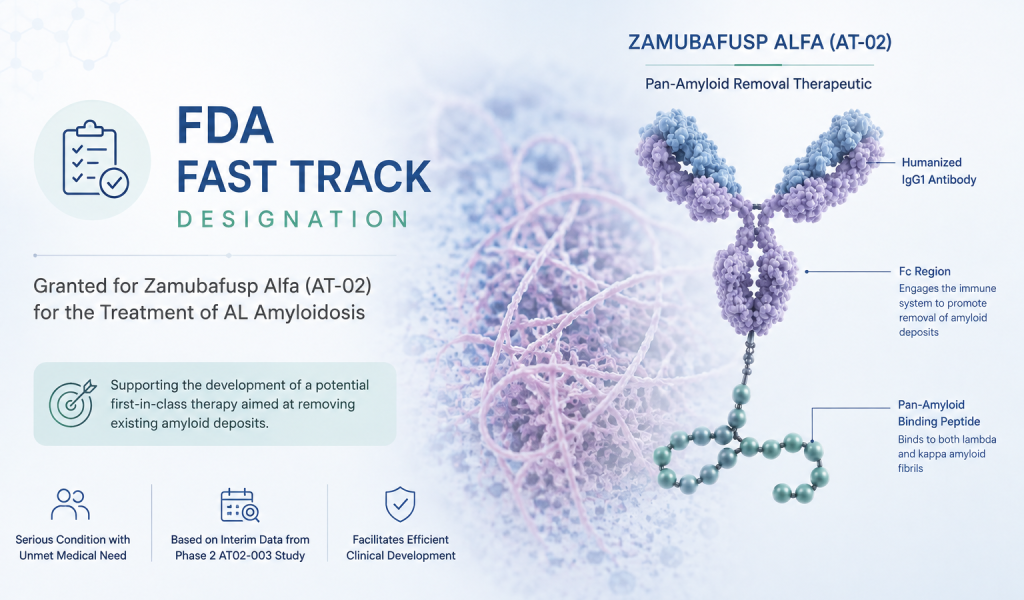
Attralus’ zamubafusp alfa (AT-02) receives FDA Fast Track designation for AL amyloidosis based on interim data from the Phase 2 AT02-003 study.
Written By: Siddhi Bhadekar,
M. Pharm (QA)
Reviewed By: Pharmacally Editorial Team
Attralus has announced that the U.S. Food and Drug Administration has granted Fast Track designation to zamubafusp alfa (AT-02) for the treatment of immunoglobulin light chain (AL) amyloidosis, a rare, progressive, debilitating, and often fatal condition.
Zamubafusp alfa has been evaluated in a completed Phase 1 study and an ongoing open-label Phase 2 study, both of which have enrolled patients with AL amyloidosis. According to Attralus, clinical data from the Phase 1/2 program demonstrate that zamubafusp alfa has the potential to address an important unmet medical need in AL amyloidosis.
FDA Fast Track Designation Based on Phase 2 Interim Data
The FDA Fast Track designation was granted based on interim AL amyloidosis data from the Phase 2 AT02-003 study (NCT05951049), which were presented at the 67th American Society of Hematology (ASH) Annual Meeting and Exposition in Orlando, Florida, held December 6-9, 2025.
All study participants have completed their study visits, and Attralus expects to report final data from the program during the second half of 2026.
Glen Firestone, President of Attralus, said the company is pleased to receive Fast Track designation for zamubafusp alfa in AL amyloidosis. He noted that current approved therapies for AL amyloidosis target light-chain production, while a significant unmet need remains for therapies capable of removing existing toxic amyloid fibrils that contribute to organ damage and mortality.
Firestone said the designation will allow Attralus to work closely with FDA on the clinical development pathway for AT-02.
FDA Fast Track Program Supports Expedited Development
FDA Fast Track designation is intended to facilitate and expedite the development and review of drugs and biologics intended to treat serious or life-threatening conditions that have the potential to address an unmet medical need.
The designation provides sponsors with opportunities for more frequent interactions with the FDA review division to discuss development plans and potential expedited development approaches. Fast Track programs can also benefit from Rolling Review of a marketing application, while Priority Review may be available if the applicable criteria are met.
Fast Track designation does not establish the safety or efficacy of zamubafusp alfa or guarantee regulatory approval.
Zamubafusp Alfa Designed to Remove Existing Amyloid Deposits
Zamubafusp alfa is Attralus’ lead pan-amyloid removal (PAR) therapeutic candidate for systemic amyloidosis. It is a humanized IgG1 monoclonal antibody genetically fused with the company’s proprietary pan-amyloid binding peptide.
The peptide enables zamubafusp alfa to bind both lambda and kappa types of amyloid deposits. The Fc region of the antibody is designed to recruit immune mechanisms involved in the removal of amyloid deposits bound by zamubafusp alfa.
Preclinical studies have shown that zamubafusp alfa can bind multiple amyloid types in major organs, induce macrophage-mediated phagocytosis, and remove amyloid.
Orphan Designations in AL and ATTR Amyloidosis
Zamubafusp alfa has received four orphan designations across the United States and European Union.
In the United States, the FDA has granted Orphan Drug Designation to zamubafusp alfa for the treatment of both AL amyloidosis and transthyretin-associated amyloidosis (ATTR).
In Europe, the European Medicines Agency’s Committee for Orphan Medicinal Products (COMP) has adopted positive opinions recommending orphan medicinal product designation for zamubafusp alfa for both ATTR and immunoglobulin light-chain-associated (AL) amyloidosis.
AL Amyloidosis Remains a Significant Unmet Medical Need
Immunoglobulin light-chain-associated amyloidosis is a progressive, systemic, multiorgan orphan disease associated with significant morbidity. The disease most commonly affects the heart and kidneys.
Worldwide, an estimated 74,000 patients are living with AL amyloidosis. In the United States, prevalence is approximately 25,000, with about 4,500 new patients diagnosed annually.
AL amyloidosis is caused by small B-cell clones that produce toxic light chains. These abnormal light chains misfold and form amyloid deposits that accumulate in tissues and can impair organ function.
The combination of daratumumab, cyclophosphamide, bortezomib, and dexamethasone (dara-CyBorD) are the current standard of care for many patients with newly diagnosed AL amyloidosis, with achieving a profound hematologic response an early treatment goal.
However, there are no approved therapies that directly target the removal of established amyloid deposits, leaving a significant unmet need for patients with persistent organ dysfunction, particularly cardiac or renal dysfunction.
Path Forward
The FDA Fast Track designation provides a regulatory pathway for continued development of zamubafusp alfa in AL amyloidosis. Attralus is advancing the candidate through its Phase 1/2 program as it evaluates its potential to address the unmet need for therapies targeting established amyloid deposits.
Reference

Siddhi Rajendra Bhadekar (Linkedin) is an M.Pharm professional with expertise in medical and scientific writing, literature review, publication writing, and evidence synthesis, supported by four peer-reviewed publications.
She brings working knowledge of ICH-GCP, MedDRA, pharmacovigilance, ADR/AE reporting, clinical data management, and regulatory documentation.
With experience across pharmaceutical R&D, Quality Control, and Quality Assurance, she combines scientific research skills with strong attention to accuracy and detail.
Her background in manuscript development, publication planning, and scientific communication enables her to translate complex healthcare information into clear, reliable content.