
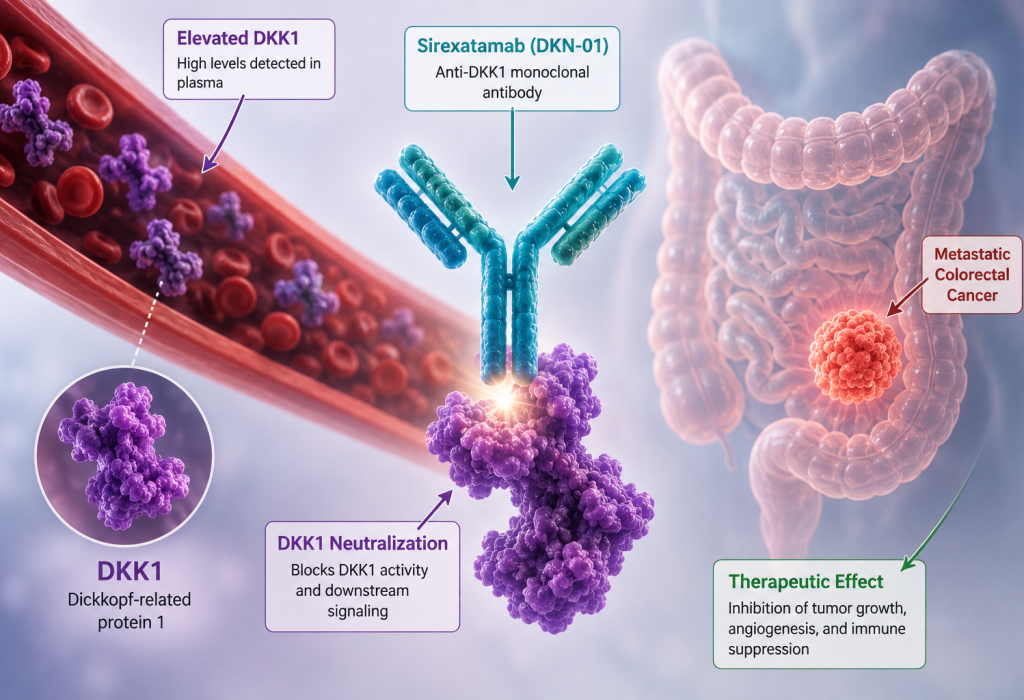
Leap Therapeutics’ sirexatamab missed the overall PFS endpoint in 2L mCRC, but greater benefit was observed in patients with elevated plasma DKK1.
Written By: Kirti Kumbhar, PharmD
Reviewed By: Pharmacally Editorial Team
Results from Leap Therapeutics’ randomized Phase 2 DeFianCe study of sirexatamab (DKN-01) in second-line metastatic colorectal cancer (2L mCRC) have been published in Clinical Cancer Research. The peer-reviewed publication provides a detailed evaluation of efficacy, safety, and the role of baseline plasma Dickkopf-related protein 1 (DKK1) as a treatment-selection biomarker. While the study missed its primary endpoint in the overall intent-to-treat (ITT) population, three complementary biomarker analyses demonstrated that sirexatamab benefit increased with rising baseline plasma DKK1 levels.
Primary Endpoint & Overall Efficacy
The DeFianCe trial (NCT05480306) evaluated 188 patients with advanced mCRC whose disease progressed after one prior systemic therapy. Patients received sirexatamab combined with FOLFIRI/mFOLFOX6 and bevacizumab or chemotherapy plus bevacizumab alone.
In the overall ITT population, median progression-free survival (PFS) was 9.2 months with sirexatamab versus 8.3 months with control (HR 0.84; 95% CI, 0.58–1.21;). Median overall survival (OS) was not reached in either arm (HR 0.83; 95% CI, 0.46–1.48), while objective response rate (ORR) was 35.1% versus 26.6%. The final ITT analysis saw 119 PFS events versus 145 planned, which reduced statistical power in a biologically heterogeneous population.
Biomarker Findings & Plasma DKK1 Correlation
Treatment benefit increased consistently alongside baseline plasma DKK1 levels. Three statistical approaches—continuous treatment-by-DKK1 interaction modeling (for PFS; for OS), a biomarker-adaptive threshold (BAT) analysis, and median/upper-quartile subgroup evaluations—supported treatment-effect heterogeneity:
- DKK1 Above Median (n=88): Sirexatamab improved median PFS to 9.0 versus 7.1 months (HR 0.61), median OS to Not Reached versus 14.4 months (HR 0.42), and ORR to 38.0% versus 23.7%.
- DKK1 Upper Quartile (n=44): Sirexatamab produced a median PFS of 9.4 versus 5.9 months (HR 0.46), median OS of Not Reached versus 9.5 months (HR 0.17), and an ORR of 44.0% versus 15.8%.
Higher baseline DKK1 also proved prognostic in the control arm, with poorer outcomes as baseline levels increased. This supports the hypothesis that DKK1-high disease represents an aggressive, biologically distinct form of colorectal cancer.
Biological Rationale & Safety Profile
Baseline plasma DKK1 was detectable in all patients across an eight-fold dynamic range, with good concordance between SomaScan and MSD assay platforms (Spearman). In contrast, DKK1 mRNA expression was low in most tumor samples, supporting the rationale for circulating plasma DKK1 over tumor tissue expression. Sirexatamab neutralizes secreted DKK1, a key regulator of Wnt signaling involved in tumor progression, angiogenesis, and immune regulation.
The safety profile remained comparable between study arms. Grade adverse events occurred in 59.3% of sirexatamab-treated patients versus 67.0% in the control group, while serious adverse events occurred in 19.8% and 19.3%, respectively. Adverse events led to sirexatamab discontinuation in only 4.4% of patients.
Expert Perspective & Patient Selection
The DeFianCe findings provide a clear scientific basis for prospective biomarker-selected evaluation rather than all-comer development. The FDA granted Fast Track designation in May 2026 for sirexatamab in combination with chemotherapy and bevacizumab for DKK1-high mCRC following prior systemic therapy. Experts highlight that circulating DKK1 provides an accessible liquid biomarker to identify patients facing a poorer prognosis under standard care who stand to gain the greatest benefit from sirexatamab.
Study Limitations
The authors note that the biomarker analyses were exploratory, involved small subgroups, were not adjusted for multiplicity, and were not designed to establish a validated treatment-selection threshold. Additionally, RAS mutation imbalances across certain DKK1 subgroups require careful evaluation in future trials.
Future Development Strategy
The DeFianCe data establishes the rationale for a biomarker-selected Phase 3 clinical trial. Further plasma proteomic, paired tissue-plasma, immune, angiogenic, Wnt-pathway, and genomic analyses are underway to refine patient selection criteria, advance companion diagnostic development, and clarify the broader biology of DKK1-high disease.
Reference

About the Writer
Kirti Kumbhar (LinkedIn) is an M.Pharm graduate with experience in Quality Assurance at Lupin Limited and a strong interest in clinical research, regulatory affairs, and Trial Master File (TMF) management. She has developed knowledge of regulatory documentation, quality systems, compliance, and healthcare research through her professional experience. Passionate about clinical development and continuous learning, Kirti is committed to supporting high-quality healthcare documentation, regulatory excellence, and research-driven healthcare advancements.