
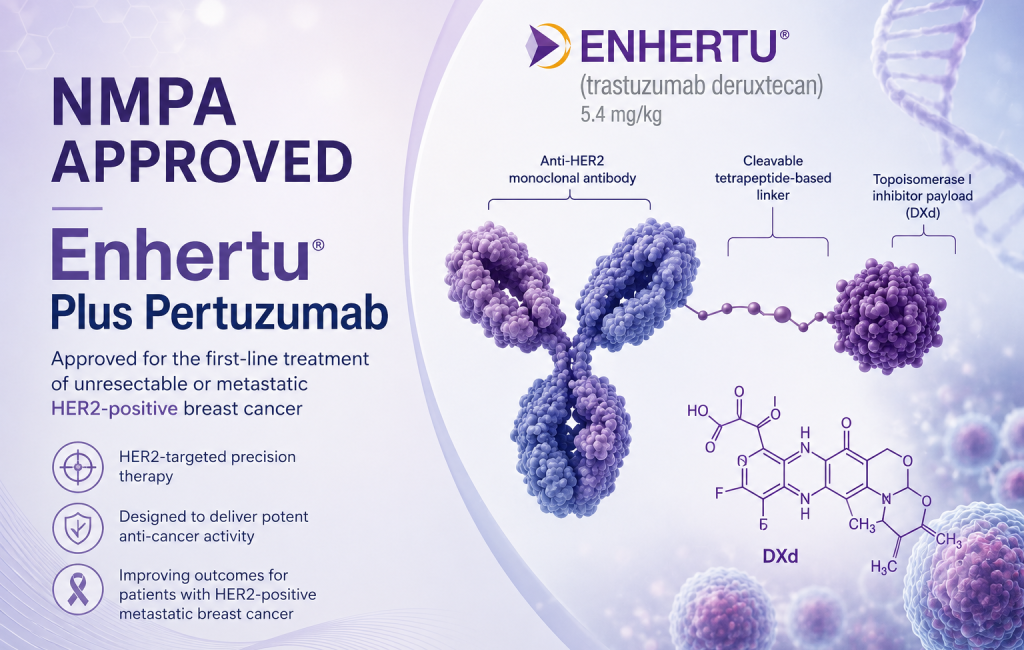
China approves Enhertu plus pertuzumab for first-line HER2-positive metastatic breast cancer after DESTINY-Breast09 showed longer progression-free survival.
Written By: Kalyani Boharapi,
M.Pharm (Reg. Affairs)
Reviewed By: Pharmacally Editorial Team
China’s National Medical Products Administration (NMPA) has approved Enhertu® (trastuzumab deruxtecan) in combination with pertuzumab for the first-line treatment of adult patients with unresectable or metastatic HER2-positive breast cancer. The approval is based on results from the pivotal DESTINY-Breast09 (NCT04784715) Phase 3 trial, in which the combination improved progression-free survival and tumor response outcomes compared with taxane, trastuzumab, and pertuzumab (THP). This is the fourth new approval for Enhertu in China in less than a year and brings the therapy to eight approved indications in the country.
DESTINY-Breast09 Showed Longer Progression-Free Survival
DESTINY-Breast09 is a global, multicenter, randomized, open-label Phase 3 trial evaluating Enhertu alone or in combination with pertuzumab versus THP as first-line treatment for HER2-positive metastatic breast cancer. The results were presented at the 2025 American Society of Clinical Oncology (ASCO) Annual Meeting and subsequently published in The New England Journal of Medicine.
In the trial, Enhertu plus pertuzumab reduced the risk of disease progression or death by 44% compared with THP (HR 0.56; 95% CI: 0.44–0.71; p<0.00001). Patients had not received prior chemotherapy or HER2-targeted therapy or had received neoadjuvant or adjuvant HER2-targeted therapy more than six months before diagnosis of advanced or metastatic disease.
Median progression-free survival (PFS), assessed by blinded independent central review (BICR), was 40.7 months with Enhertu plus pertuzumab compared with 26.9 months with THP. Consistent PFS improvement was observed across prespecified subgroups, including the China subgroup, where efficacy results were consistent with the global findings.
Higher Response Rate and Longer Duration of Response
The confirmed objective response rate (ORR) was 85.1% with Enhertu plus pertuzumab compared with 78.6% with THP. Complete responses occurred in 15.1% and 8.5% of patients, respectively, while partial responses occurred in 70.0% of patients in both groups.
Median duration of response was 39.2 months with Enhertu plus pertuzumab compared with 26.4 months with THP, exceeding three years with the combination.
Safety Profile Consistent with Previous Studies
The safety profile of Enhertu plus pertuzumab was consistent with previous clinical trials, with no new safety concerns identified. In a pooled analysis of 431 patients treated with the combination across two clinical studies, common Grade 3 or Grade 4 adverse reactions included neutropenia (24.8%), hypokalemia (13.2%), anemia (10.7%), diarrhea (7.4%), fatigue (7.2%), and thrombocytopenia (7.0%).
Grade 5 adverse reactions occurred in 0.9% of patients, including interstitial lung disease (ILD) in 0.5%. Treatment discontinuation due to an adverse reaction occurred in 15.3% of patients, with ILD being the most frequent adverse reaction associated with permanent discontinuation at 6.0%.
Trial Design and Global Approval
DESTINY-Breast09 enrolled 1,157 patients across Africa, Asia, Europe, North America, and South America. Patients were randomized 1:1:1 to Enhertu monotherapy, Enhertu plus pertuzumab, or THP. The primary endpoint was PFS assessed by BICR, while secondary endpoints included investigator-assessed PFS, overall survival, ORR, duration of response, pharmacokinetics, and safety. The Enhertu monotherapy comparison with THP remains blinded and will continue through the final PFS analysis.
Enhertu plus pertuzumab is also approved as a first-line treatment for HER2-positive metastatic breast cancer in India, Israel, Saudi Arabia, Singapore, South Korea, Switzerland, Taiwan, the United Arab Emirates, and the United States.
About Enhertu
Enhertu (trastuzumab deruxtecan) is a HER2-directed antibody-drug conjugate developed using Daiichi Sankyo’s proprietary DXd ADC technology. It consists of a HER2 monoclonal antibody linked to topoisomerase I inhibitor DXd payloads through tetrapeptide-based cleavable linkers.
The China approval expands Enhertu plus pertuzumab into the first-line treatment setting for HER2-positive metastatic breast cancer and is supported by DESTINY-Breast09 findings showing longer PFS, higher response rates, and more durable responses compared with THP.
Reference

About the Writer
Kalyani Boharapi (LinkedIn) is a pharmacy professional and healthcare writer currently pursuing an M.Pharm in Regulatory Affairs at Dr. D. Y. Patil College of Pharmacy, with interests in pharmaceutical regulations, drug development, and healthcare innovation. She has academic exposure to dossier preparation, scientific writing, and regulatory documentation. Kalyani has also completed certification courses in Generative AI, AI in Pharma, and Bioinformatics, and actively participates in pharmaceutical conferences to stay updated with emerging trends and advancements in the healthcare and pharmaceutical industry.