
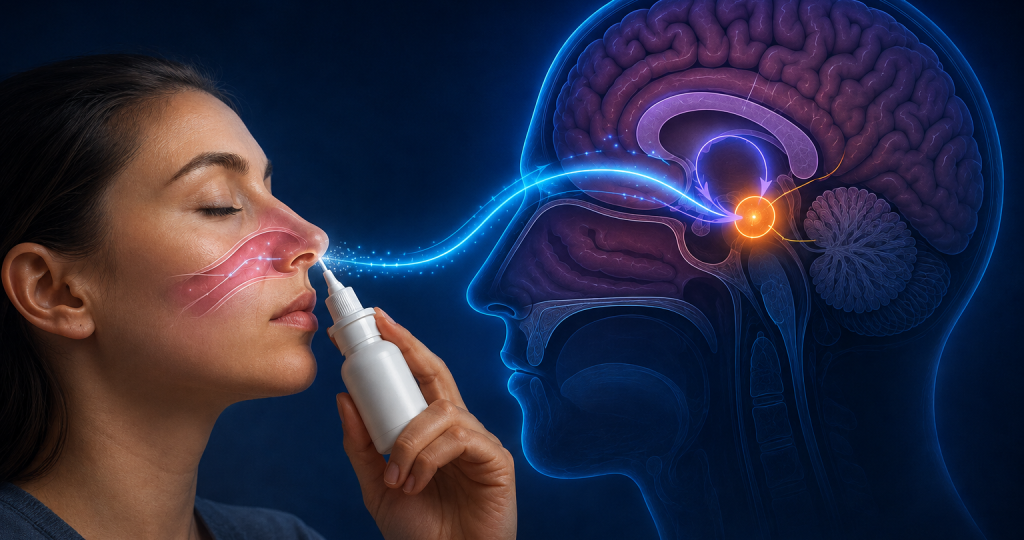
Vistagen reported favorable repeat-dose safety and encouraging efficacy signals for intranasal fasedienol in a Phase 2 trial for social anxiety disorder, including nominally significant benefits in patients with very severe disease.
Written By: Anshu Gupta, PharmD
Reviewed By: Pharmacally Editorial Team
Fasedienol nasal spray demonstrated favorable safety with repeat dosing and showed consistent efficacy signals across multiple clinical endpoints in adults with social anxiety disorder. Prespecified analyses also identified statistically significant improvements in patients with very severe disease, supporting upcoming regulatory discussions with the FDA.
Vistagen has reported positive topline results from an exploratory Phase 2 clinical trial evaluating repeat-dose fasedienol nasal spray for the acute treatment of anxiety triggered by public speaking in adults with social anxiety disorder (SAD). Although the study was not powered to establish statistically significant differences between treatment groups, repeat-dose and single-dose fasedienol both produced favorable safety results and demonstrated consistent efficacy signals across primary, secondary, and exploratory endpoints.
Intranasal Neurocircuitry Therapy Targets Anxiety Without Systemic Drug Exposure
Fasedienol is an investigational intranasal pherine being developed as a rapid-onset treatment for social anxiety disorder. Unlike conventional anti-anxiety medicines such as benzodiazepines, the therapy is administered in microgram doses and is intended to act through nose-to-brain neurocircuitry involving the nasal-limbic amygdala pathway rather than through systemic absorption.
According to Vistagen, fasedienol has shown no observed activity at dopamine, opioid, or GABA-A receptors commonly associated with abuse potential, sedation, and dependence, offering a differentiated therapeutic approach for acute anxiety episodes.
Social anxiety disorder affects more than 30 million adults in the United States and can substantially impair social functioning, work performance, and quality of life while increasing the risk of depression, substance use disorders, and suicidal ideation.
Phase 2 Trial Demonstrated Favorable Safety with Repeat Dosing
The multicenter, randomized, double-blind, placebo-controlled Phase 2 study (NCT06809179) enrolled 61 adults with social anxiety disorder. Participants received either two 3.2 µg doses of fasedienol administered ten minutes apart, a single 3.2 µg dose, or placebo before a standardized public speaking challenge. The trial also included an open-label extension.
The primary objective was to evaluate safety and tolerability of repeat dosing.
Repeat-dose fasedienol demonstrated a safety profile comparable to single-dose treatment, with no new safety findings and adverse events consistent with previous clinical studies.
Efficacy Signals Favored Fasedienol Across Multiple Endpoints
The primary efficacy endpoint assessed the change in Subjective Units of Distress Scale (SUDS) scores between baseline and randomized public speaking sessions.
Both active treatment groups showed greater reductions in distress than placebo. The pooled fasedienol group achieved a mean SUDS reduction of 15.0 points compared with 6.8 points for placebo, corresponding to a moderate effect size (Cohen’s d=0.46), although the between-group difference did not reach statistical significance (p=0.10). Similar numerical improvements were observed with both repeat-dose and single-dose treatment.
A prespecified subgroup analysis identified stronger treatment effects among patients with very severe social anxiety, defined by a baseline Liebowitz Social Anxiety Scale (LSAS) score of 95 or higher.
Within this subgroup, pooled fasedienol reduced SUDS scores by 16.2 points compared with only 1.6 points for placebo, achieving nominal statistical significance (p=0.04; Cohen’s d=0.78). Single-dose treatment also reached nominal significance (p=0.05), while repeat dosing showed an even larger numerical treatment effect despite a smaller sample size.
Secondary analyses further supported clinical activity. Clinician Global Impression of Improvement (CGI-I) responder rates reached 47% with repeat-dose fasedienol compared with 19% for placebo. Patient Global Impression of Change (PGI-C) responder rates were 42% versus 19%, respectively.
Among patients with very severe disease, repeat-dose responder rates were fourfold or greater than placebo across both clinician- and patient-reported assessments.
An exploratory analysis evaluating anticipatory anxiety immediately before public speaking also favored repeat-dose treatment. Repeat-dose fasedienol reduced anticipatory anxiety by 19.3 points compared with 0.9 points for placebo, achieving nominal statistical significance (p=0.01; Cohen’s d=0.83).
Findings Strengthen Regulatory Planning
Chief Medical Officer Dr. Angel Angelov said the consistency of efficacy signals across multiple endpoints, together with previous Phase 2 and Phase 3 findings, strengthens the evidence supporting fasedienol’s clinical activity. He noted that the pronounced benefit observed in patients with very severe social anxiety mirrors results previously reported from the PALISADE-4 Phase 3 trial (NCT06615557) and will guide discussions with the U.S. Food and Drug Administration on a potential registrational pathway.
Fasedienol remains Vistagen’s lead neurocircuitry-focused investigational therapy and is currently in Phase 3 clinical development for social anxiety disorder. The company plans to use the cumulative evidence from its clinical program, including these repeat-dose findings, to determine the next regulatory steps toward potential registration.
Reference
About the Writer
Anshu Gupta (LinkedIn) is a PharmD professional and healthcare writer with interests in clinical research, pharmacovigilance, regulatory affairs, and medical writing. She has presented research at academic conferences and completed certifications in Good Clinical Practice (GCP), ICH-GCP, and drug safety. Passionate about clinical trials and evidence-based medicine, she is committed to translating scientific evidence into accurate, reliable, and accessible healthcare content.