
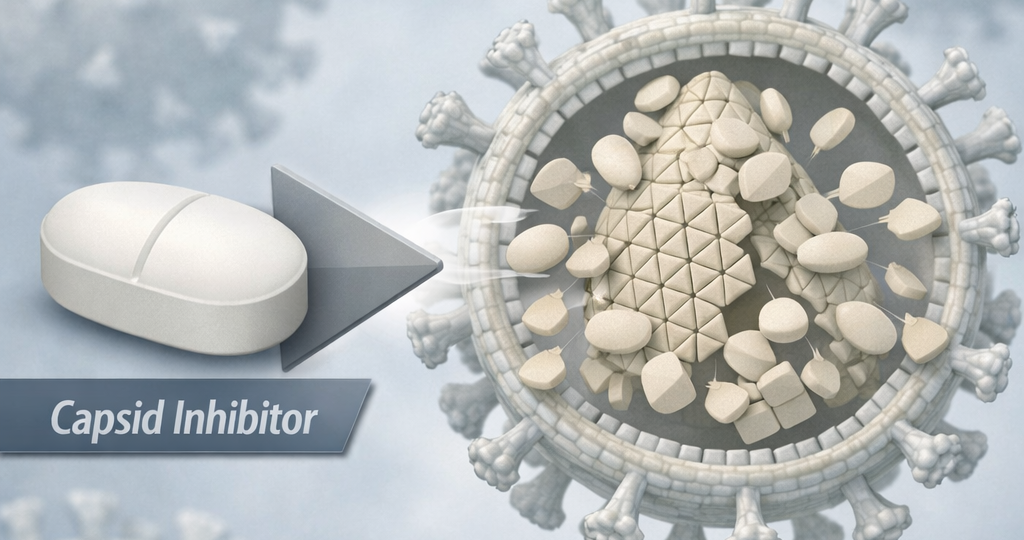
ViiV Healthcare’s HIV-1 capsid inhibitor VH-499 reduced viral load by up to 2.2 log10 copies/mL with favorable safety in the Phase 2a CINNAMON trial.
Written By: Shaik Yasmeen, PharmD
Reviewed By: Pharmacally Editorial Team
A proof-of-concept Phase 2a study found that the investigational HIV-1 capsid inhibitor VH-499 reduced viral load by up to 2.2 log 10 copies/mL over 10 days of monotherapy while maintaining a favorable safety profile. The findings support continued development of VH-499 as part of a long-acting antiretroviral treatment regimen.
ViiV Healthcare’s investigational HIV-1 capsid inhibitor VH4011499 (VH-499) demonstrated strong antiviral activity, favorable pharmacokinetics, and good tolerability in adults with HIV-1 who had not previously received antiretroviral therapy (ART), according to results from the Phase 2a CINNAMON trial (NCT06039579) published in Clinical Infectious Diseases. The study provides proof-of-concept evidence supporting VH-499 as a potential component of future long-acting HIV treatment regimens.
Scientific and Clinical Context
Despite major advances in HIV treatment, lifelong ART remains necessary for most people living with HIV. Long-acting therapies may improve adherence, reduce treatment burden, minimize stigma, and simplify long-term disease management.
VH-499 belongs to a newer class of antiretroviral agents known as capsid inhibitors, which interfere with several essential stages of the HIV replication cycle, including viral uncoating, reverse transcription, nuclear import, and capsid disassembly. Because the viral capsid is highly conserved, it represents an attractive therapeutic target with the potential for infrequent dosing. Earlier preclinical and Phase 1 studies also suggested that VH-499 has minimal CYP3A4 drug-drug interaction potential, an advantage for patients receiving multiple medications.
Phase 2a CINNAMON Trial Results
The randomized, double-blind, placebo-controlled Phase 2a study enrolled 23 adults with untreated HIV-1 infection across sites in Argentina, France, Germany, Mexico, and Spain. Participants received oral VH-499 at 25 mg, 100 mg, or 250 mg, or placebo, on Days 1 and 6 during a 10-day monotherapy period before initiating standard-of-care ART on Day 11. The primary endpoint evaluated the maximum change in plasma HIV-1 RNA through Day 11.
VH-499 produced substantial reductions in viral load across all dose groups:
- 25 mg: mean maximum decline of −1.8 log10 copies/mL
- 100 mg: −1.8 log10 copies/mL
- 250 mg: −2.2 log10 copies/mL
- Placebo: −0.2 log10 copies/mL
Investigators also observed an exposure-response relationship, with higher VH-499 concentrations associated with greater reductions in viral load.
Resistance emergence remained uncommon. Nineteen of twenty participants receiving VH-499 (95%) developed no treatment-emergent capsid resistance-associated mutations during monotherapy. One participant receiving the lowest 25 mg dose developed a Q67H-associated resistance mutation but subsequently achieved viral suppression after transitioning to dolutegravir/lamivudine therapy.
Safety and Pharmacokinetic Findings
VH-499 was generally well tolerated throughout the study.
All adverse events were mild or moderate, with no serious adverse events, no deaths, and no treatment discontinuations. The most frequently reported adverse events were headache and puncture-site hematoma related to study procedures. Drug-related adverse events occurred in three participants, were largely grade 1 in severity, and typically resolved within two days. No clinically meaningful changes were observed in laboratory parameters, electrocardiograms, vital signs, or suicidality assessments.
Pharmacokinetic analyses showed plasma drug exposures compatible with less frequent dosing. The highest 250 mg dose achieved the greatest drug exposure and antiviral activity, while overall exposure increased with dose and demonstrated limited accumulation between the two administered doses.
Executive Perspective
The investigators concluded that VH-499 combines potent antiviral efficacy with favorable tolerability and pharmacokinetic characteristics that support its development as a long-acting HIV therapy. They also noted its potentially advantageous drug-drug interaction profile compared with currently available capsid inhibitors, which could benefit patients managing multiple comorbidities and concomitant medications.
Path Forward
Although CINNAMON was a small proof-of-concept study, the results provide encouraging evidence for continued clinical development of VH-499. Ongoing studies are evaluating long-acting injectable formulations of the investigational capsid inhibitor, with the goal of incorporating VH-499 into complete long-acting treatment regimens that could expand therapeutic options and support global efforts to reduce HIV transmission in line with the UNAIDS 2030 targets.
Reference

About the Writer
Shaik Yasmeen (LinkedIn) is a Pharm.D graduate with interests in clinical pharmacy, pharmacovigilance, and medical writing. She has gained experience through hospital clinical postings, patient case reviews, case presentations, and literature evaluation. Passionate about evidence-based healthcare, she is committed to creating accurate and engaging medical content while continuously expanding her professional knowledge.