
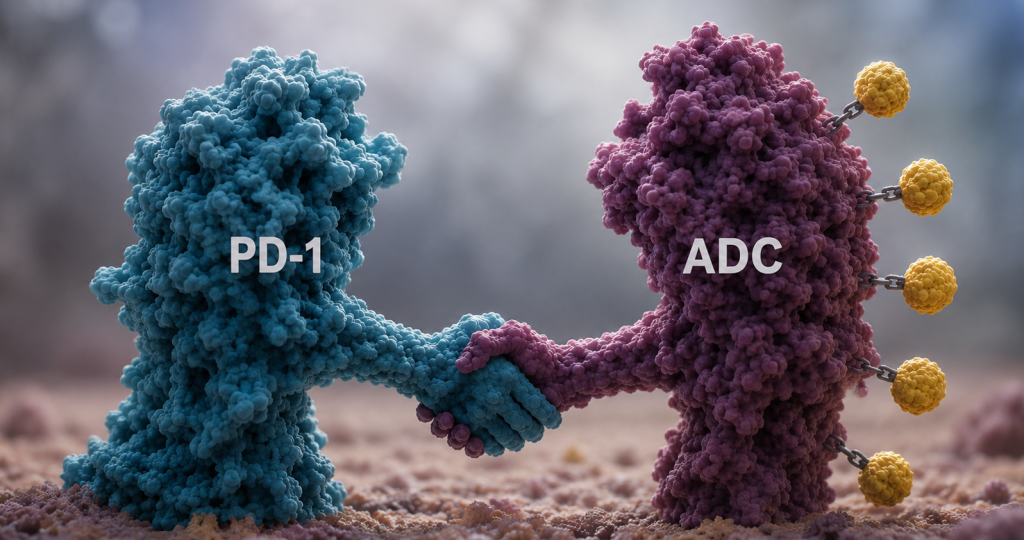
FDA approves Keytruda and Padcev perioperative regimen for muscle‑invasive bladder cancer, the first platinum‑free PD‑1 + ADC therapy showing superior survival and recurrence outcomes across cisplatin‑eligible and ineligible patients.
Written By: Kirti Kumbhar, M.Pharm (QA)
Reviewed By: Pharmacally Editorial Team
The U.S. Food and Drug Administration (FDA) has approved Merck’s Keytruda (pembrolizumab) and Keytruda QLEX (pembrolizumab and berahyaluronidase alfa-pmph), each in combination with Pfizer and Astellas’ Padcev (enfortumab vedotin-ejfv), as neoadjuvant treatment followed by adjuvant therapy after radical cystectomy for adults with muscle-invasive bladder cancer (MIBC), regardless of cisplatin eligibility. The decision establishes the first approved perioperative PD-1 inhibitor plus antibody-drug conjugate (ADC) regimen and the first platinum-free treatment approach available for patients across both cisplatin-eligible and cisplatin-ineligible populations.
The expanded approval is supported by results from the Phase 3 EV-304 trial, also known as KEYNOTE-B15 (NCT04700124), which evaluated perioperative Padcev plus pembrolizumab in cisplatin-eligible patients. It builds on the FDA’s November 2025 approval based on the Phase 3 EV-303/KEYNOTE-905 trial, which established the regimen for patients who were ineligible for cisplatin. Together, the two studies extend the combination across the full spectrum of patients with MIBC.
EV-304 demonstrated superior efficacy over standard chemotherapy
EV-304 was a randomized, open-label, Phase 3 study enrolling 808 patients with previously untreated muscle-invasive bladder cancer eligible for cisplatin-based chemotherapy. Participants received either perioperative Padcev plus pembrolizumab or standard neoadjuvant gemcitabine and cisplatin followed by radical cystectomy.
The combination achieved the trial’s primary endpoint by reducing the risk of disease recurrence, progression, or death by 47% compared with standard chemotherapy (hazard ratio [HR] 0.53; 95% confidence interval [CI], 0.41-0.70; p<0.0001). At two years, an estimated 79.4% of patients receiving the combination remained event-free compared with 66.2% in the chemotherapy arm.
The regimen also produced a statistically significant overall survival benefit, reducing the risk of death by 35% versus neoadjuvant chemotherapy (HR 0.65; 95% CI, 0.48-0.89; p=0.0029). In addition, the pathological complete response (pCR) rate reached 55.8%, compared with 32.5% for gemcitabine plus cisplatin (p<0.0001).
Patients in the investigational arm received four neoadjuvant cycles of Padcev plus pembrolizumab before surgery, followed by adjuvant therapy for a planned total of nine Padcev cycles and 17 pembrolizumab cycles across the perioperative treatment period. The primary endpoint was event-free survival, while key secondary endpoints included overall survival and pathological complete response.
Safety profile remained consistent with previous experience
The safety findings were consistent with the established profiles of both therapies, and no new safety signals were identified. Grade 3 or higher adverse events occurred in 75.7% of patients receiving perioperative Padcev plus pembrolizumab compared with 67.2% of patients treated with neoadjuvant gemcitabine and cisplatin. Known immune-mediated adverse reactions associated with pembrolizumab and adverse events previously reported with Padcev remained consistent with earlier clinical experience.
Experts highlight a new perioperative treatment option
Christopher Hoimes, DO, Director of the Bladder Cancer Program and Center for Cancer Immunotherapy at Duke Cancer Institute and a principal investigator of EV-304, said treating patients before and after surgery without platinum chemotherapy significantly reduced recurrence while improving overall survival. He noted that the regimen has the potential to become a new standard of care for muscle-invasive bladder cancer.
Aamir Malik, Executive Vice President and Chief U.S. Commercial Officer at Pfizer, said the approval brings the first platinum-free perioperative regimen with a demonstrated survival benefit to adults with muscle-invasive bladder cancer regardless of cisplatin eligibility.
Moitreyee Chatterjee-Kishore, PhD, MBA, Head of Oncology Development at Astellas, added that the approval represents the first platinum-free treatment approach in nearly 25 years to outperform standard chemotherapy in this setting. Merck’s Dr. Marjorie Green said the combined evidence from KEYNOTE-B15 and KEYNOTE-905 expands perioperative treatment options for patients irrespective of cisplatin eligibility and reinforces the clinical value of the combination in earlier-stage disease.
Broadening perioperative treatment for muscle-invasive bladder cancer
Bladder cancer remains one of the most frequently diagnosed malignancies worldwide, with muscle-invasive disease accounting for approximately one-quarter to one-third of newly diagnosed cases. Cisplatin-based neoadjuvant chemotherapy followed by radical cystectomy has been the standard perioperative treatment for more than two decades, yet nearly half of patients experience disease recurrence after surgery, while many are unable to receive cisplatin because of underlying medical conditions.
With this expanded FDA approval, Keytruda plus Padcev becomes the first perioperative PD-1 inhibitor and ADC combination approved regardless of cisplatin eligibility, offering a chemotherapy-free treatment option that has demonstrated significant improvements in event-free survival, overall survival, and pathological complete response compared with the previous standard of care.
Reference

About the Writer
Kirti Kumbhar (LinkedIn) is an M.Pharm graduate with experience in Quality Assurance at Lupin Limited and a strong interest in clinical research, regulatory affairs, and Trial Master File (TMF) management. She has developed knowledge of regulatory documentation, quality systems, compliance, and healthcare research through her professional experience. Passionate about clinical development and continuous learning, Kirti is committed to supporting high-quality healthcare documentation, regulatory excellence, and research-driven healthcare advancements.