
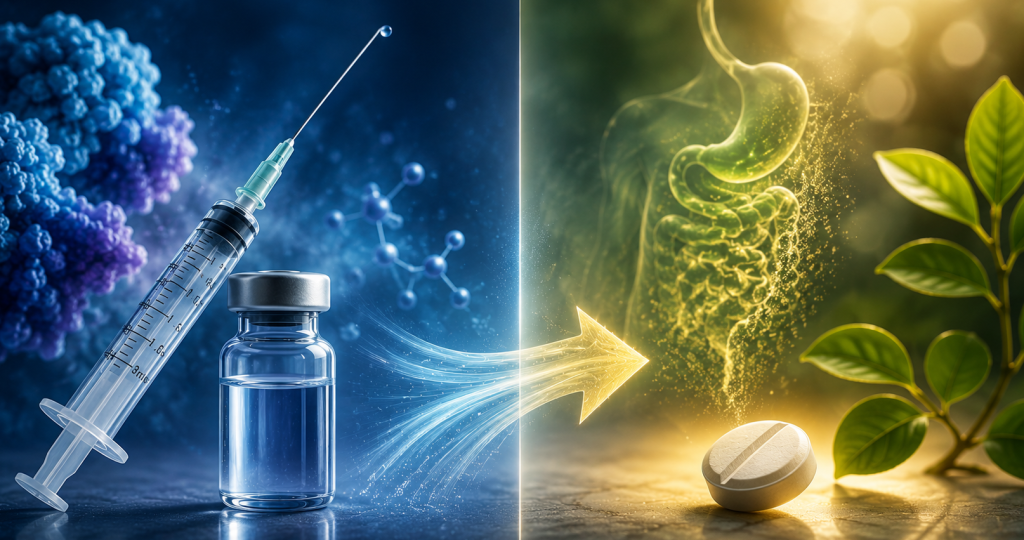
Discover how advances in oral drug delivery technologies are transforming injectable therapies into convenient oral medicines, reshaping the future of chronic disease treatment.
Written By: Fariha Sameen, PharmD
Reviewed By: Pharmacally Editorial Team
For decades, injectable medicines have been the cornerstone of treating chronic diseases with biologics such as peptides, proteins, hormones, and monoclonal antibodies. Their large molecular size and fragile structure make them highly susceptible to degradation in the gastrointestinal tract, leaving intravenous and subcutaneous administration as the only practical option. While effective, injectable therapies often present challenges including needle anxiety, poor long-term adherence, frequent hospital visits, and dependence on cold-chain storage.
Today, advances in pharmaceutical engineering are beginning to reshape that landscape. Novel absorption technologies, permeability enhancers, and innovative oral drug designs are enabling several therapies once limited to injections to be delivered as tablets or capsules. Although oral biologics remain one of the greatest formulation challenges, recent clinical successes signal a new era in chronic disease management.
Why Oral Delivery Remains a Scientific Challenge
The gastrointestinal tract is naturally designed to digest proteins rather than absorb them intact. Therapeutic peptides encounter highly acidic gastric conditions (pH 1.5–3.5) and digestive enzymes such as pepsin, trypsin, and chymotrypsin, which rapidly degrade them. Those that survive must still cross the protective mucus layer and tightly connected intestinal epithelial cells before entering systemic circulation.
Consequently, most orally administered peptides achieve systemic bioavailability below 2%. Oral semaglutide, for example, achieves approximately 1% bioavailability compared with the substantially higher exposure achieved through subcutaneous administration, highlighting the remarkable engineering required to transform injectable biologics into effective oral medicines.
Engineering the Next Generation of Oral Biologics
One of the most successful approaches uses Sodium N-[8-(2-hydroxybenzoyl) amino] caprylate (SNAC), an absorption enhancer that temporarily raises the local gastric pH, reducing pepsin activity while promoting transcellular absorption across the stomach lining. This technology forms the foundation of oral semaglutide.
Another strategy employs Transient Permeability Enhancer (TPE) technology, which temporarily modulates tight junction proteins such as claudins and occludins, allowing larger peptide molecules to pass between intestinal epithelial cells. Mechanical innovations are also advancing. Investigational platforms such as the RaniPill capsule deploy biodegradable microneedles into the intestinal wall after reaching the small intestine, enabling painless drug delivery because the intestinal lining lacks pain-sensing nerve endings.
Together, these innovations represent a shift from conventional formulation science to sophisticated drug delivery engineering.
Medicines Already Changing Clinical Practice
The most notable success is Rybelsus® (oral semaglutide), approved by the US FDA in 2019 as the first oral glucagon-like peptide-1 (GLP-1) receptor agonist for type 2 diabetes. Previously available only as injectable semaglutide formulations, Rybelsus demonstrated clinically meaningful reductions in HbA1c while providing patients with a needle-free treatment option.
Another milestone followed in 2020 with Mycapssa® (oral octreotide), the first oral somatostatin analogue approved for adults with acromegaly. The capsule enables eligible patients previously maintained on long-acting injectable octreotide to continue therapy orally while preserving biochemical control through maintenance of insulin-like growth factor-1 (IGF-1) levels.
Another important milestone came in 2026 with the FDA approval of Foundayo® (orforglipron) an oral GLP-1 receptor agonist, is a small molecule rather than a peptide, allowing oral administration without absorption enhancers or strict fasting requirements while delivering therapeutic effects traditionally associated with injectable GLP-1 medicines.
The pipeline continues to expand, with oral insulin programs, oral GLP-2 analogues for short bowel syndrome, parathyroid hormone therapies, and other peptide medicines progressing through clinical development, reflecting the growing diversity of oral biologic technologies.
Benefits and Remaining Challenges
Successfully replacing injections with oral medicines extends beyond patient convenience. Oral therapies can improve adherence, reduce dependence on infusion centres, simplify long-term disease management, and potentially lessen cold-chain requirements for selected medicines, improving treatment accessibility in resource-limited settings.
However, important challenges remain. Low bioavailability still requires significantly larger quantities of active pharmaceutical ingredient than injectable formulations, increasing manufacturing complexity and cost. Drug absorption can also vary with food intake, gastric emptying, and individual gastrointestinal physiology.
Long-term safety remains another important consideration. Researchers continue to evaluate whether chronic exposure to permeability enhancers could influence intestinal barrier integrity, microbiome composition, or unintended absorption of luminal substances during prolonged treatment. In addition, large protein therapeutics such as monoclonal antibodies remain particularly difficult to deliver orally because of their size, structural complexity, and extremely limited gastrointestinal permeability.
A New Era for Drug Delivery
The transition from injectable medicines to oral therapies represents one of the most important advances in modern pharmaceutical science. Rather than replacing every injectable medicine, these technologies are expanding treatment options for carefully selected biologics and chronic diseases. The success of oral semaglutide and oral octreotide demonstrates that innovations once considered scientifically unattainable are now improving patient care. As formulation technologies continue to evolve, oral biologics are poised to make chronic treatment more convenient, accessible, and patient-centred without compromising therapeutic effectiveness.

About the Writer
Fariha Sameen, PharmD (LinkedIn), is a clinical pharmacy professional with hands-on experience in patient counselling, medication review, therapeutic monitoring, and clinical documentation across multiple departments. She has experience identifying and assessing drug-related problems and supporting medication safety practices. Her interests include pharmacovigilance, ADR reporting, clinical research, and medical writing focused on clear, evidence-based communication.