
Explore the differences between antibody-drug conjugates (ADCs) and bispecific antibodies, their mechanisms, landmark approvals, clinical applications, and future role in precision cancer therapy.
Cancer treatment has shifted dramatically from conventional chemotherapy toward precision medicine, where therapies are designed to target the unique biological characteristics of tumors while minimizing damage to healthy tissues. This evolution has been driven by advances in molecular biology, antibody engineering, and immunology, leading to the emergence of highly targeted biologic therapies. Among the most significant innovations are Antibody-Drug Conjugates (ADCs) and Bispecific Antibodies (BsAbs), two rapidly expanding therapeutic platforms that are reshaping cancer care through distinct yet complementary mechanisms.
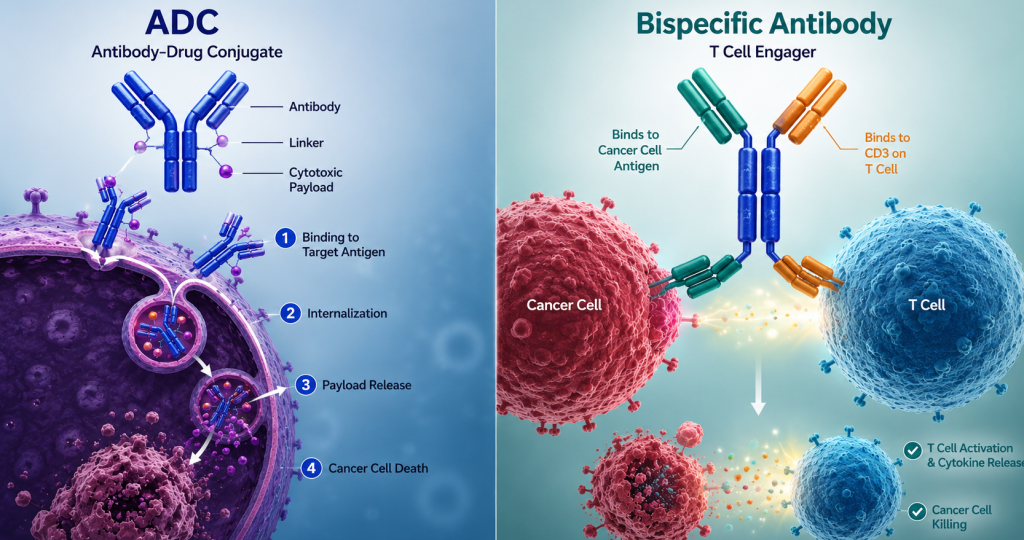
Although both technologies are built upon monoclonal antibodies, their therapeutic strategies differ fundamentally. ADCs function as precision drug delivery systems that transport highly potent cytotoxic agents directly into cancer cells, whereas bispecific antibodies redirect the patient’s immune system to identify and eliminate malignant cells. Their growing clinical success has resulted in multiple regulatory approvals, expanding indications, and substantial investment, positioning both platforms as cornerstones of next-generation oncology.
Antibody-Drug Conjugates: Delivering Precision Chemotherapy
Antibody-drug conjugates combine three essential components: a monoclonal antibody that recognizes a tumor-associated antigen, a chemical linker, and a highly potent cytotoxic payload. After binding to the target antigen, the ADC is internalized by the cancer cell, where the linker releases the payload to induce cell death while limiting systemic exposure. The success of an ADC depends on selecting an antigen that is highly expressed on tumor cells but minimally present in healthy tissues, along with stable linker chemistry that prevents premature drug release. Some modern ADCs also exhibit a beneficial “bystander effect,” allowing released payloads to eliminate neighbouring tumor cells with lower antigen expression.
The rapid evolution of ADCs has been driven by landmark regulatory approvals supported by pivotal clinical trials. Trastuzumab deruxtecan (Enhertu®) transformed the field following the DESTINY-Breast04 study, which demonstrated significant improvements in progression-free and overall survival in patients with HER2-low metastatic breast cancer and led to FDA approval that expanded HER2-targeted therapy beyond traditional HER2-positive disease. Likewise, Sacituzumab govitecan (Trodelvy®) has improved outcomes in metastatic triple-negative breast cancer and advanced urothelial carcinoma, while Enfortumab vedotin (Padcev®) has become a key treatment option for advanced bladder cancer. Despite their clinical success, ADCs may encounter resistance through antigen loss or impaired intracellular processing, and adverse events such as interstitial lung disease, peripheral neuropathy, and neutropenia require careful monitoring.
Bispecific Antibodies: Redirecting the Immune System
Unlike ADCs, bispecific antibodies do not carry cytotoxic drugs. Instead, they are engineered to bind two different molecular targets simultaneously, most commonly a tumor-associated antigen and the CD3 receptor on T cells. By physically bringing immune cells into close contact with cancer cells, they trigger targeted immune-mediated destruction without relying on intracellular drug delivery. This mechanism differs from immune checkpoint inhibitors, which enhance existing immune responses by removing inhibitory signals rather than actively redirecting immune cells.
Clinical development of bispecific antibodies has accelerated rapidly over the past decade. Blinatumomab (Blincyto®) established the proof of concept as the first approved bispecific T-cell engager for B-cell acute lymphoblastic leukemia. More recently, Teclistamab (Tecvayli®) and Epcoritamab (Epkinly®) have demonstrated high response rates in heavily pretreated patients with multiple myeloma and diffuse large B-cell lymphoma, respectively, leading to regulatory approvals and expanding treatment options in hematologic malignancies. Numerous investigational programs targeting GPRC5D, DLL3, HER2, and other tumor-associated antigens are now advancing through late-stage clinical development, with increasing emphasis on extending this approach to solid tumors. However, immune activation may result in cytokine release syndrome, infections, prolonged cytopenias, and neurological toxicities that require specialized clinical management.
Complementary Platforms Driving Precision Oncology
Although ADCs and bispecific antibodies are often compared, they are increasingly viewed as complementary rather than competing technologies. ADCs excel when direct intracellular delivery of potent chemotherapy can selectively eliminate antigen-expressing tumor cells, particularly in solid tumors. Bispecific antibodies, by contrast, harness the patient’s immune system and have demonstrated exceptional activity in hematologic cancers where T-cell engagement can produce durable responses. Treatment selection increasingly depends on tumor biology, biomarker expression, previous therapies, and individual patient characteristics rather than choosing one platform over the other.
The Future of Targeted Cancer Therapy
Innovation across both platforms continues at an unprecedented pace. Researchers are developing next-generation ADCs with improved linker chemistry, novel payloads, and dual-payload designs, while newer bispecific antibodies are targeting emerging biomarkers such as B7-H3, HER3, CLDN18.2, DLL3, and GPRC5D. Combination strategies integrating ADCs with immunotherapies are under active investigation, alongside experimental bispecific ADCs that combine dual-antigen targeting with precision drug delivery to improve tumor selectivity and overcome resistance associated with heterogeneous antigen expression. Advances in biomarker-driven patient selection, protein engineering, and artificial intelligence-assisted drug discovery are expected to further improve treatment precision and expand the range of cancers that can benefit from these innovative therapies.
As precision oncology continues to evolve, antibody-drug conjugates and bispecific antibodies are poised to play increasingly complementary roles in cancer treatment. Their ability to selectively target tumors through distinct biological mechanisms is redefining therapeutic possibilities, offering clinicians more individualized treatment strategies while improving outcomes for patients across a broad spectrum of malignancies.

About the Writer
Farha Farheen, PharmD (LinkedIn) is a pharmacy professional with a strong interest in pharmacovigilance and clinical research. She has completed her Doctor of Pharmacy (Pharm.D) along with her internship as a Clinical Pharmacist. She has hands-on experience in adverse drug reaction (ADR) reporting, safety data documentation, and pharmacovigilance workflows, and is proficient in using VigiFlow. She is also a patent holder for an antibacterial formulation enriched with bioactive substances, granted by the German Patent and Trademark Office.