
Explore why PD-1 remains the dominant immune checkpoint target in oncology, from its biology and landmark clinical trials to biomarkers, resistance, and future therapies.
Immune checkpoint inhibitors (ICIs) have transformed cancer treatment by shifting the therapeutic focus from directly targeting tumor cells to restoring antitumor immunity. Among all immune checkpoint pathways explored over the past three decades, programmed cell death protein-1 (PD-1) has emerged as the most successful therapeutic target, becoming the cornerstone of modern cancer immunotherapy.
Although surgery, chemotherapy, radiotherapy, targeted therapy, and hormone therapy have improved outcomes across many cancers, durable disease control in advanced malignancies remained limited because tumors evade immune surveillance through impaired antigen presentation, immunosuppressive signaling, metabolic reprogramming, and activation of inhibitory immune checkpoints.
From Discovery to Breakthrough
PD-1 was discovered in 1992 by Tasuku Honjo during studies of programmed cell death. It was later recognized as a key inhibitory receptor regulating adaptive immunity rather than apoptosis. Together with James P. Allison’s work on CTLA-4, this discovery established immune checkpoint blockade as a new therapeutic strategy and earned the 2018 Nobel Prize in Physiology or Medicine. The first approvals of pembrolizumab and nivolumab for advanced melanoma in 2014 marked the beginning of a new era, and PD-1 inhibitors have since expanded across more than twenty malignancies, including NSCLC, renal cell carcinoma, head and neck cancer, urothelial carcinoma, hepatocellular carcinoma, gastrointestinal cancers, cervical and endometrial cancers, triple-negative breast cancer, classical Hodgkin lymphoma, and biomarker-defined tumor-agnostic indications.
Molecular Basis of PD-1 Blockade
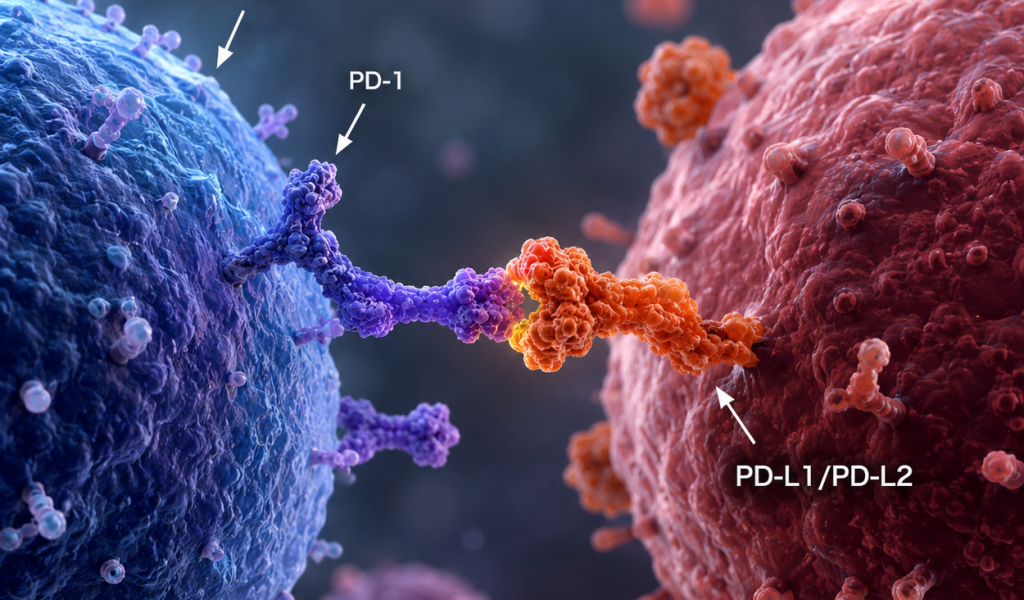
PD-1 is expressed on activated T lymphocytes and several other immune cell populations, while its ligands PD-L1 and PD-L2 are found on antigen-presenting cells, normal tissues, and many tumor cells. Engagement of PD-1 with its ligands recruits the phosphatase SHP-2, suppressing T-cell receptor signaling and driving T-cell exhaustion within the tumor microenvironment. Therapeutic antibodies block this interaction, restoring T-cell activity and enabling immune-mediated tumor elimination.
Unlike CTLA-4, which regulates early T-cell activation in lymphoid tissues, PD-1 primarily suppresses activated T cells within peripheral tissues and the tumor microenvironment. This localized mechanism contributes to both its superior clinical efficacy and lower incidence of severe immune-related toxicities.
Why PD-1 Became the Dominant Checkpoint Target
PD-1 blockade occupies a unique position in cancer immunotherapy because it directly reverses adaptive immune resistance at the tumor site. Tumors frequently upregulate PD-L1 in response to interferon-γ released by activated T cells, allowing them to evade immune destruction. Blocking the PD-1/PD-L1 interaction restores existing antitumor immunity where immune suppression is greatest.
The favorable safety profile of PD-1 inhibitors has also enabled widespread combination strategies with chemotherapy, radiotherapy, targeted therapies, anti-angiogenic agents, antibody-drug conjugates, and cellular therapies. Although PD-L1 inhibitors such as atezolizumab, durvalumab, and avelumab have demonstrated important clinical activity, PD-1 inhibitors have shown broader efficacy across tumor types and remain the foundation of most immunotherapy-based treatment strategies.
Clinical Evidence Across Cancer Types
The clinical success of PD-1 inhibition is supported by landmark trials across multiple malignancies. Studies including CheckMate-066 and KEYNOTE-006 established durable survival benefits in advanced melanoma, while KEYNOTE-024, KEYNOTE-189, KEYNOTE-407, and CheckMate-227 transformed first-line treatment for advanced NSCLC. Similar practice-changing evidence from CheckMate-025, CheckMate-214, KEYNOTE-426, KEYNOTE-048, CheckMate-141, and KEYNOTE-045 established PD-1 blockade as a standard treatment for renal cell carcinoma, head and neck squamous cell carcinoma, and urothelial carcinoma.
PD-1 inhibitors have since expanded into gastrointestinal cancers, hepatocellular carcinoma, triple-negative breast cancer, cervical cancer, mismatch repair-deficient endometrial cancer, cutaneous squamous cell carcinoma, and classical Hodgkin lymphoma. Their clinical impact further extended through tumor-agnostic approvals for microsatellite instability-high (MSI-H), mismatch repair-deficient (dMMR), and tumor mutational burden-high (TMB-H) cancers, representing a major shift toward biomarker-driven precision oncology.
Current Challenges and Future Directions
Despite remarkable clinical success, durable responses are achieved in only a subset of patients. Primary and acquired resistance arise through impaired antigen presentation, defective interferon signaling, immune-excluded tumor microenvironments, compensatory checkpoint activation, and tumor evolution.
Current biomarkers, including PD-L1 expression, MSI-H/dMMR, and TMB, improve patient selection but remain imperfect. Ongoing research is evaluating integrated biomarker approaches combining circulating tumor DNA, tumor-infiltrating lymphocytes, immune gene signatures, T-cell receptor profiling, gut microbiome analysis, and artificial intelligence-assisted pathology.
Emerging checkpoints such as LAG-3, TIGIT, TIM-3, VISTA, B7-H3, and BTLA are being investigated primarily as combination partners rather than replacements for PD-1 inhibition, further reinforcing its central role in immuno-oncology.
Clinical Implications and Future Research
More than a decade after its first regulatory approvals, PD-1 blockade remains the defining advance in cancer immunotherapy. Its strong biological rationale, durable clinical benefit, favorable safety profile, and broad applicability across solid tumors and hematological malignancies have established it as the backbone of modern oncology. As precision biomarkers, rational combination therapies, and next-generation immunotherapies continue to evolve, PD-1 is expected to remain the therapeutic foundation upon which future advances in cancer immunotherapy are built.

About the Writer
Meghana Jinka (LinkedIn) is a Pharm.D graduate with a strong interest in clinical pharmacy, clinical research, pharmacovigilance, and medical writing. She has developed expertise in evaluating scientific literature, interpreting clinical data, and communicating complex medical information in a clear and accessible manner. Through clinical training, patient counseling, and healthcare awareness activities, she has gained practical experience in evidence-based medicine and patient-centered care. Passionate about healthcare communication, Meghana is committed to developing accurate, engaging, and evidence-based healthcare documents that support healthcare professionals and the wider community.