
Evommune has discontinued EVO756 in chronic spontaneous urticaria after a Phase 2b trial failed to meet efficacy endpoints, shifting focus to atopic dermatitis, migraine, and advancing IL‑18BP fusion protein EVO301.
Written By: Disha Jadhao, BPharm
Reviewed By: Pharmacally Editorial Team
Evommune has discontinued the development of its oral MRGPRX2 antagonist EVO756 for chronic spontaneous urticaria (CSU) after the drug failed to meet the primary endpoint in a randomized, double-blind, placebo-controlled Phase 2b trial. The study showed no significant improvement in disease activity at 12 weeks across any of the tested dose regimens compared with placebo, prompting the company to end the program in CSU.
The global Phase 2b study (NCT06873516) enrolled 160 adults with moderate-to-severe antihistamine-refractory CSU across the United States, Europe, Canada, and Japan. Participants were randomized to receive one of three EVO756 dose regimens or placebo. The primary endpoint assessed the mean change in Urticaria Activity Score over seven days (UAS7) after 12 weeks of treatment.
MRGPRX2 Remains a Target in Chronic Inflammatory Diseases
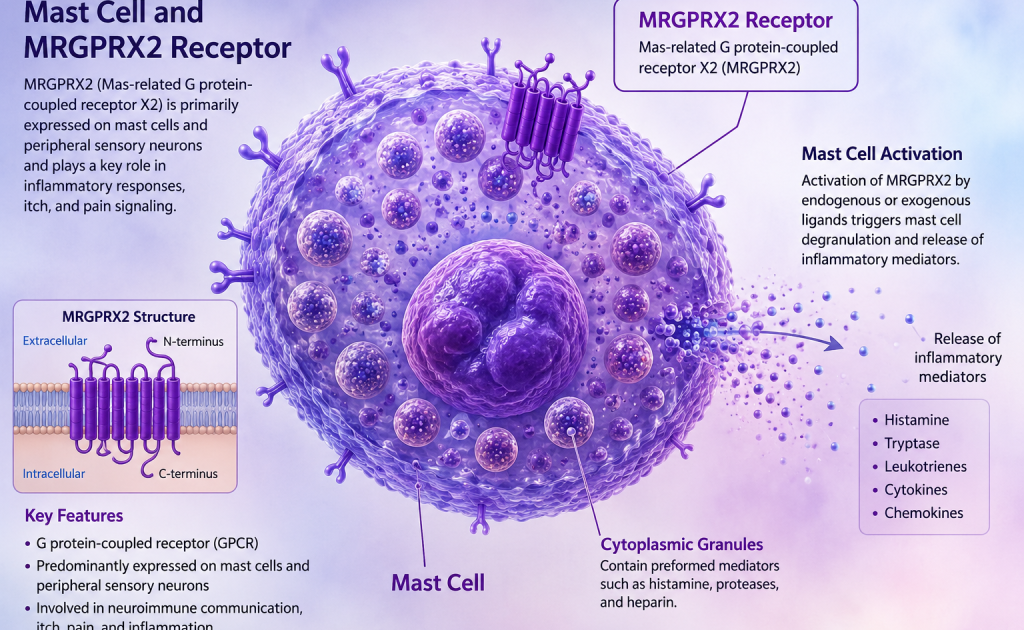
EVO756 is a first-in-class oral small-molecule antagonist of Mas-related G protein-coupled receptor X2 (MRGPRX2), a receptor primarily expressed on mast cells and peripheral sensory neurons. MRGPRX2 plays a role in neuroimmune signaling and mast cell activation, making it a potential therapeutic target for inflammatory diseases characterized by itch, pain, and immune dysregulation.
Although the mechanism remains scientifically attractive, the latest findings indicate that MRGPRX2 inhibition with EVO756 did not translate into meaningful clinical benefit for patients with chronic spontaneous urticaria.
Phase 2b Results Showed No Clinical Benefit in CSU
The trial did not achieve its primary efficacy endpoint, as none of the evaluated doses significantly reduced UAS7 scores at Week 12 compared with placebo. While the efficacy results ended further development in CSU, the study confirmed that EVO756 was safe and well tolerated across all treatment groups.
Chief Medical Officer Dr. Eugene Bauer noted that EVO756 had previously demonstrated target engagement in Phase 1 studies and encouraging Phase 2 activity in chronic inducible urticaria. However, the lack of efficacy in the current study does not support continued development for CSU. He added that the favorable safety profile supports further evaluation of the molecule in other inflammatory conditions.
Pipeline Focus Shifts to Atopic Dermatitis and Migraine
Despite the negative CSU outcome, Evommune continues to position EVO756 as a potential therapy for other chronic inflammatory diseases.
President and Chief Executive Officer Luis Peña said the company remains on track to report top-line Phase 2b data in atopic dermatitis during the third quarter of 2026. Screening has also begun for a Phase 2b migraine prophylaxis trial, with patient dosing expected to start shortly.
The company is simultaneously advancing EVO301, its long-acting SAFA-IL-18BP fusion protein, after recently reporting positive Phase 2a proof-of-concept results in atopic dermatitis. EVO301 neutralizes excessive IL-18 signaling using a native human IL-18 binding protein fused to serum albumin to extend half-life and improve tissue distribution. Evommune plans to move the candidate into a larger Phase 2b trial in atopic dermatitis.
With cash expected to support operations through 2028, the company plans to focus on advancing its broader inflammatory disease pipeline while shifting resources away from EVO756 in chronic spontaneous urticaria.
Reference

About the Writer
Disha Sanjay Jadhao (LinkedIn) is a pharmacy graduate and healthcare writer with a strong interest in clinical documentation and simplifying healthcare information for better reader understanding. She is enthusiastic, adaptable, and eager to take on new challenges while contributing to clear, accurate, and engaging medical and pharmaceutical content.